Mayan ruins without the crowds, try these instead!
If you want to experience exceptional Mayan ruins but away from the throngs of mass tourism and without queuing for a photo, I have three sites that will leave you speechless.

Ek Balam
How to get there
Ek Balam is an imposing site 25km north of Valladolid. Currently there is no public transport available.
However there are options:
Joining a tour (there are tours from Cancun and from Valladolid) like this one, although they are much pricer than going to Chichen Itza;
https://www.cancun-adventure.com/en/tour/ek-balam-adventure
Taxi: likely to cost around £15/20 one way
Private driver: we went with our driver, which ferried us around for 5 days, prices were very reasonable and he was quite knowledgeable.
See post here: https://blog.worldswithout.net/oscar-the-best-driver-in-yucatan/

The site
Ek Balam was inhabited from the Preclassic until the Postclassic period, roughly between 700CE and 1000 CE. it was the seat of a Mayan kingdom and it took part in the rise to prominence of Puuc settlements which are associated with a unique architectural style (the “Puuc style”) that represents a technological and stylistical change from previous construction techniques.
Major Puuc sites include Uxmal, Sayil, Labna, Kabah.

After this period, the population started to decrease dramatically, down to 10%, as Ekʼ Balam was slowly becoming vacant. There are several theories as to why it was eventually abandoned and to the degree of haste at which it was abandoned, with an attack from outside invaders being the most plausible as a defence wall, built hurriedly, has been found to be the most recent construction on site.

The place is renowned for the preservation of the plaster on the tomb of Ukit Kan Lek Tokʼ, a king buried in the side of the largest pyramid.
This pyramid is climbable, unlike others, but if you do, please do so with respect. And be careful. It’s super steep, as very likely these constructions were not meant to be climbed on by people.


Current Ek Balam entrance fees are: Nationals: 211 MXN (US$12) International visitors: 531 MXN (US$29) Children under 12: 90 MXN (US$5)
Uxmal
Uxmal is one of the most important Mayan sites in Mexico.

Probably built around 700AD in magnificent Puuc style, it’s dedicated to the God Chaac, God of rains. Uxmal is an extraordinary astronomical and engineering marvel depicting advanced cosmological processes and recording solstice events that are used to emphasise the ruler’s power as custodian of knowledge.
I strongly suggest to hire a guide which will bring this marvellous site to justice.
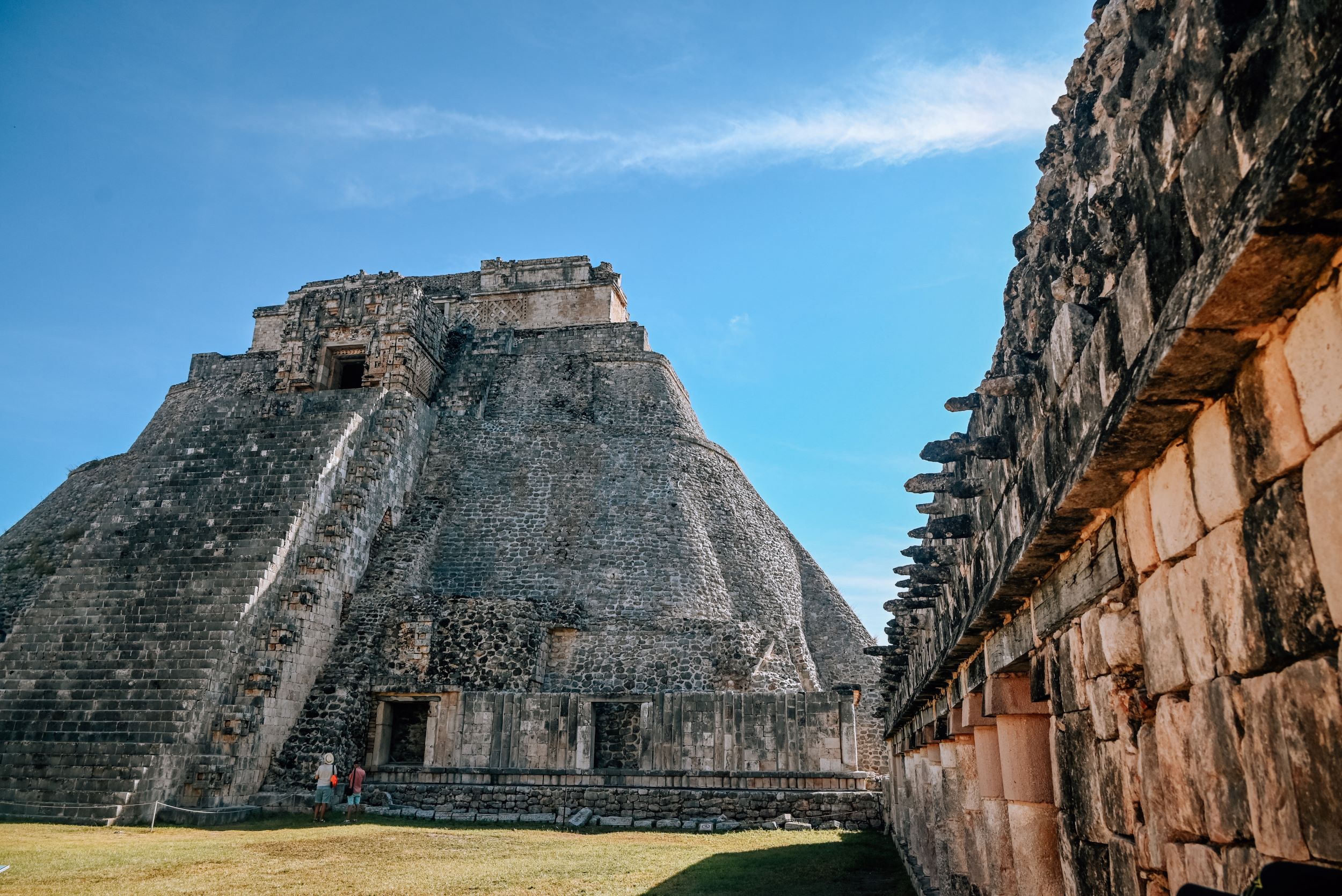
The Pyramid of the Magician

The first building one encounters is the incredible Pyramid of the Magician, an unusual sight for a pyramid as it is oval in shape.
Five different layers have been found, not just the latest one built on top of a previous pyramid, but inside the previous pyramid.
Several water cisterns surround the site, likely for both drinkable water and ritual purposes.


The Nunnery

The Nunnery is a show of masterful engineering in both construction and acoustics.
This place was likely used for rituals and dances as some of the platforms have wide stages.

Everything is constructed with care and purpose.
Starting with the South Building at the lowest level, the East and West Buildings are elevated so that the bottom of the South Building’s frieze is level with the platforms these building rest upon and the top of the South Building is level with the bottom of their friezes.
In turn, the North Building is elevated so that its platform is level with the bottom of the East and West Building friezes.
It is an intricate puzzle of stone.


There are jaw- dropping numerical symmetries here and a possible re enactment of the creation of man, in the representation of those little thatched houses.
The acoustics are astonishing here. Clap your hands and you will hear a clear and crisp echo resounding back at you.
Exiting the Nunnery and through the ballcourt, we reach what is my favourite building: the Governor’s palace.
The Governor’s Palace

A building radiating beauty, it is also perfectly aligned with Venus as morning star and to record solar equinoxes and solstice events.
It seems that theGovernor’s palace was designed to serve as an astronomical observatory and was probably connected with the cult of the planet Venus.
A line almost perfectly perpendicular to the facade of the Governor’s palace passed from the central doorway, over the base of the Picote column that stands in the middle of the courtyard.

The Picote reminded me of the Egyptian Benben stone, or the Greek Omphalos (the navel of the world) or the Shiva Linga. To my surprise, the guide explained that the Picote did represent, as well, for the Maya, the navel of the world.
From there, the line of Venus sat over the centre of the platform of the bicephalic jaguar throne, and then extended to meet the mound on the horizon.
Archaeologists have found that this alignment points almost exactly to the azimuth of Venus rise when the planet attained its maximum southerly declination around the year A.D. 750.

The Governor’s palace also depicts the two calendars the Mayans were following, the ritualistic one with 260 days and the common one for ordinary people.
The serpent imagery is omnipresent in Mayan architecture and it pervades every building.


I could go on and on about this incredible site.
The guide I hired was a very knowledgeable one, recommended by our driver, which also did his own historical research and we ended up sitting down at one of the ruins, talking away, comparing similarities, and differences, with the Egyptian and Sumerian astronomical, engineering and mythological knowledge in which I am more informed. It was an amazing conversation and we both learnt from each other.

Uxmal ticket is around 550 pesos and it is open from 8:00 am and close at 5:00 pm, every day of the week, all year round. Last access is one hour before closing time.
Kabah

As I was not yet sated with Mayan knowledge, we drove another 20 minutes down a sacbe, an ancient mayan road, to one of the most underrated site in the whole Yucatan, the ruins of Kabah.
The entrance ticket is a mere 80 pesos, and that tells how popular this site is. However, it is worth a visit.
First, it is cheap, second, you’ll likely be the only one there, third, it is exquisitely beautiful and interesting.
Just like most of the Mayan ruins we visited, Kabah as well is still largely unexcavated, with ruins that can be spotted in the dense jungle.
Most of the architecture now visible was likely built between the 7th century and 11th centuries CE, with Kabah likely meaning “strong (or powerful) hands”.

Palace of the Masks
Upon entering the site, head to the right and climb the stairs of El Palacio de los Mascarones. Standing in front of it is the Altar de los Glifos, whose immediate area is littered with many stones carved with glyphs. The palace’s facade is an amazing sight, covered in nearly 300 masks of Chaac, the rain god.


The “powerful hands”
From there, you’ll encounter two statues of men supporting columns with their arms extended.
The guide told me a legend that implied that the ruler of this place had “powerful hands” and could move stones without touching them. Hence, the name of the place.


The Palace
Walk to the plaza containing El Palacio. The palace’s broad facade has several doorways, two of which have a column in the centre. These columned doorways and the groups of decorative columnillas (little columns) on the upper part of the facade are characteristic of the Puuc architectural style.

Leaving the site and crossing the street, a path climbs the slope, skirting a stone mound—the former Gran Pirámide (Great Pyramid).
The path curves to the right and comes to a large restored monumental arch. It’s said that the sacbé, the elevated ceremonial road, leading from here goes through the jungle all the way to Uxmal, terminating at a smaller arch.

Unfortunately, nothing of the sacbé is visible, and the rest of the area west of the main road is a maze of unmarked, overgrown paths leading off into the jungle.
The whole Puuc area would need extensive excavation and research. I asked the guide if it is not done for lack of fundings. He replied fundings would be one issue, but it seems the government is not really interested at the moment.
It is a shame because there is still an immense amount of structures, heritage and discoveries hidden under the jungle. It is said that only 10% of what the area still hides, has been excavated.
I really hope some serious work of excavation and maintenance is done because the area deserves it and preserving our past is one of the keys to understand our present.