Where Dynasties Linger: Walking Through Beijing’s Echoes
After our first trip to China last year, we were not meant to come back so soon.
But there we were, on our flight to Beijing.
We had not seen Beijing on our first trip, so this time we took time to give it some undiluted attention and we thought 7 days would be enough. How wrong we were!
However, we made the best use of our days and there is plenty to keep you busy!
We have travelled quite a bit through China and every city had its charms and personal atmosphere. But Beijing was different. It had something I can only describe as: Imperial.
You’ll spot palaces and temples at nearly every turn, and don’t be surprised if you find yourself gawking from the back seat of a taxi.

Step outside the palace walls and Beijing unfolds in layers, ancient and ultra-modern, chaotic and serene. Rickshaws rattle down narrow hutongs where red lanterns sway in the breeze, while just blocks away, glass skyscrapers shimmer like portals to the future. The city hums with a rhythm all its own, a blend of incense, street food smoke, and stories whispered by old stones. It’s not just history you’re walking through, it’s memory made tangible.
And believe me, it can only be described as Imperial.


When to go
Bejing is stunning at any season, with snow in the winter, with cherry blossoms in spring, yellow leaves in autumn or lushious in summer.
We travelled end of May into June. It was scorching hot and made it difficult to sightsee. 30+ degrees Celsius every day.
Bear this in mind when planning. I would rather do September/October or April.
All attractions close early in the summer as well: 16.30/17.00 so you have no choice but to brave the heat. Or get up very early but you may encounter all the tour groups at that time.
We avoided the mornings and started visiting around 13.00, yes it was the hottest time but we skipped all the organised tour throngs and the crowds were manageable.
Organised tour vs self made tour
If you feel you ‘d rather have that extra security, you can always book the tours that interest you. Tours will usually pick you up and bring you directly to the attractions without the hassle of organising how to get there.
There are several tours, covering a multitude of activities and places: from the Forbidden city to the temple of Heaven to the Summer Palace or even the Great Wall or a combination of those. Have a look: https://www.getyourguide.com/beijing-l186/4-hour-private-tour-to-tian-anmen-square-and-forbidden-city-t459862/?partner_id=CEGJRAU&utm_medium=online_publisher&cmp=Beijing_trip
Having said that, sightseeing in Beijing is rather easy by calling a DIDI taxi from your mobile app.
If you don’t know what I am talking about, have a read to my China survival guide that tells you all you need to know before planning and getting there
Here: https://blog.worldswithout.net/from-pandas-to-pagodas-a-china-survival-travel-guide/
The unmissable Beijing spots
Beijing is a huge, sprawling city with heavy traffic, so I planned according to different areas to minimise time wasted in traffic.
The Forbidden City
The absolute star of the city.
Step beyond the huge crimson gates of the Forbidden City and it’s like time folds in on itself. For centuries, this sprawling imperial complex was the secluded heart of Chinese dynastic power—lavish, imposing, and off-limits to all but the elite.

Golden rooftops gleam beneath the sun, while carved stone lions stand guard over vast courtyards and vermilion halls. It’s hard not to feel dwarfed by the scale of it all, as if the ghosts of emperors still linger in the silence between footsteps. Actually, some say it is haunted.


If you are going without a tour, do take your time to explore, it is immense. We were there two afternoons and never got to see everything.
The palace, just like most of Bejing’s attractions, runs through a main central axis, but do sway away from that and explore the side palaces where empresses and concubines used to live.
There are little descriptions in English but they do not capture the full history, the stories and the dramas that this place has been witness of.


The Forbidden City (Palace Museum) in Beijing is open Tuesday to Sunday, and closed on Mondays (except during Chinese public holidays).
Here are the seasonal opening hours:
- April to October (Peak Season):
Open 8:30 AM – Close 5:00 PM
Last ticket sale: 4:00 PM
Last entry: 4:10 PM - November to March (Off Season):
Open 8:30 AM – Close 4:30 PM
Last ticket sale: 3:30 PM
Last entry: 3:40 PM
Tickets are best booked well in advance.
You can book them here:https://www.getyourguide.com/beijing?partner_id=CEGJRAU&utm_medium=online_publisher
The temple of Heaven
If the Forbidden City was built to dazzle, the Temple of Heaven was designed to restore cosmic harmony. Tucked within a vast imperial park, this 15th-century masterpiece of Ming architecture was where emperors prayed for good harvests—alone beneath the sky, in solemn ritual. The Hall of Prayer for Good Harvests, with its triple-gabled circular roof and deep blue tiles, looks almost otherworldly, perfectly symmetrical and entirely wooden, built without a single nail.
The atmosphere is different here—less imposing than the Forbidden City, more meditative. Locals gather in the surrounding gardens to play cards, practice Tai Chi, or sing opera beneath the cypresses. It’s a place where past and present flow together, soft and unhurried.


Don’t miss the Echo Wall, one of Beijing’s most delightful surprises. Nestled around the Imperial Vault of Heaven within the Temple of Heaven complex, this perfectly circular wall is more than just a pretty architectural flourish—it’s an acoustic marvel.
Built in the 15th century, the wall stretches about 65 meters in diameter and stands 3.7 meters high. Its smooth, curved surface was engineered with such precision that even a whisper spoken against one side can travel along the wall and be heard clearly on the opposite end. It’s like a centuries-old game of telephone, but with emperors and cosmic rituals instead of playground gossip.
Visitors love testing it out—stand at one end, have a friend at the other, and try whispering your secrets. Just make sure the courtyard isn’t too noisy, and face the right direction for the full effect.
Opening Times:
- April–October: Park 6:00–22:00; Main attractions 8:00–18:00
- November–March: Park 6:30–22:00; Attractions 8:00–17:00
❗Closed Mondays for major attractions (except public holidays) - Tickets and tours available here: https://www.getyourguide.com/beijing?partner_id=CEGJRAU&utm_medium=online_publisher
The Summer Palace
My favourite place!
Set against the shimmering expanse of Kunming Lake and crowned by Longevity Hill, the Summer Palace is a masterpiece of Chinese landscape design. Built in the 18th century as a birthday gift from Emperor Qianlong to his mother, it was envisioned as a retreat that blended imperial grandeur with natural harmony. Think pavilions perched above lotus-dotted waters, winding covered walkways painted with scenes from folklore, and bridges that seem to float across the lake like brushstrokes on silk.


The highlight? That iconic Long Corridor—728 meters of hand-painted beams, each one telling a different story. Or perhaps it’s the Seventeen-Arch Bridge, stretching elegantly across the lake like a spine of stone dragons.
And if you climb to the top of Longevity Hill, the view over the palace grounds is pure poetry—especially at sunset, when the rooftops glow gold and the lake mirrors the sky.

Step onto a dragon boat for a ride to remember!
Gliding across Kunming Lake in one of the brightly painted dragon boats feels like stepping into a scroll painting. The boats themselves are ornate, with golden dragon heads at the prow and colourful detailing that echoes imperial grandeur. As you drift past willow-lined shores, the Seventeen-Arch Bridge arches gracefully in the distance, and the reflections of pavilions ripple across the water like brushstrokes.
It’s not just scenic—it’s practical too. These boats connect key spots around the lake, like the Marble Boat and South Lake Island, making it a relaxing way to explore without retracing your steps. The ride usually lasts around 10–15 minutes, and it’s especially magical at sunset when the lake glows with warm light and the air turns still.


General Park Hours:
- April 1 – October 31 (Peak Season): 6:00 AM – 8:00 PM (last entry at 7:00 PM)
- November 1 – March 31 (Off Season): 6:30 AM – 7:00 PM (last entry at 6:00 PM)
Key Galleries and Scenic Spots (like the Tower of Buddhist Incense, Suzhou Street, and Garden of Virtue and Harmony):
- Peak Season: 8:00 AM – 6:00 PM (last entry at 5:30 PM)
- Off Season: 8:30 AM – 5:00 PM (last entry at 4:30 PM)
- Tickets and tours available here: https://gyg.me/09E8pwCC
The Lama temple
Also known as Yonghe Temple, this 17th-century complex began as a royal residence before transforming into a monastery of the Gelug school of Tibetan Buddhism. The moment you pass through its red gates, the scent of incense thickens, prayer wheels spin gently in the breeze, and golden-robed monks move quietly between halls.

The architecture is a striking blend of Han Chinese and Tibetan styles—ornate rooftops, vivid murals, and guardian lions flanking the entrances. But the true showstopper is the Maitreya Buddha in the Pavilion of Ten Thousand Happinesses: a towering 26-meter statue carved from a single piece of white sandalwood. It’s so massive that it’s listed in the Guinness Book of Records.


Despite its grandeur, the temple feels intimate. Locals come to light incense, bow in prayer, or simply sit in the courtyards beneath ancient cypress trees. It’s a place of devotion, reflection, and quiet awe.
The Lama Temple (Yonghe Temple) in Beijing is open daily from 9:00 AM to 4:30 PM, with the last entry at 4:00 PM. It’s best to arrive earlier in the day if you want to experience the quieter, more contemplative atmosphere.
Tickets and tours available here: https://gyg.me/FKsfnXUA
Beihai park
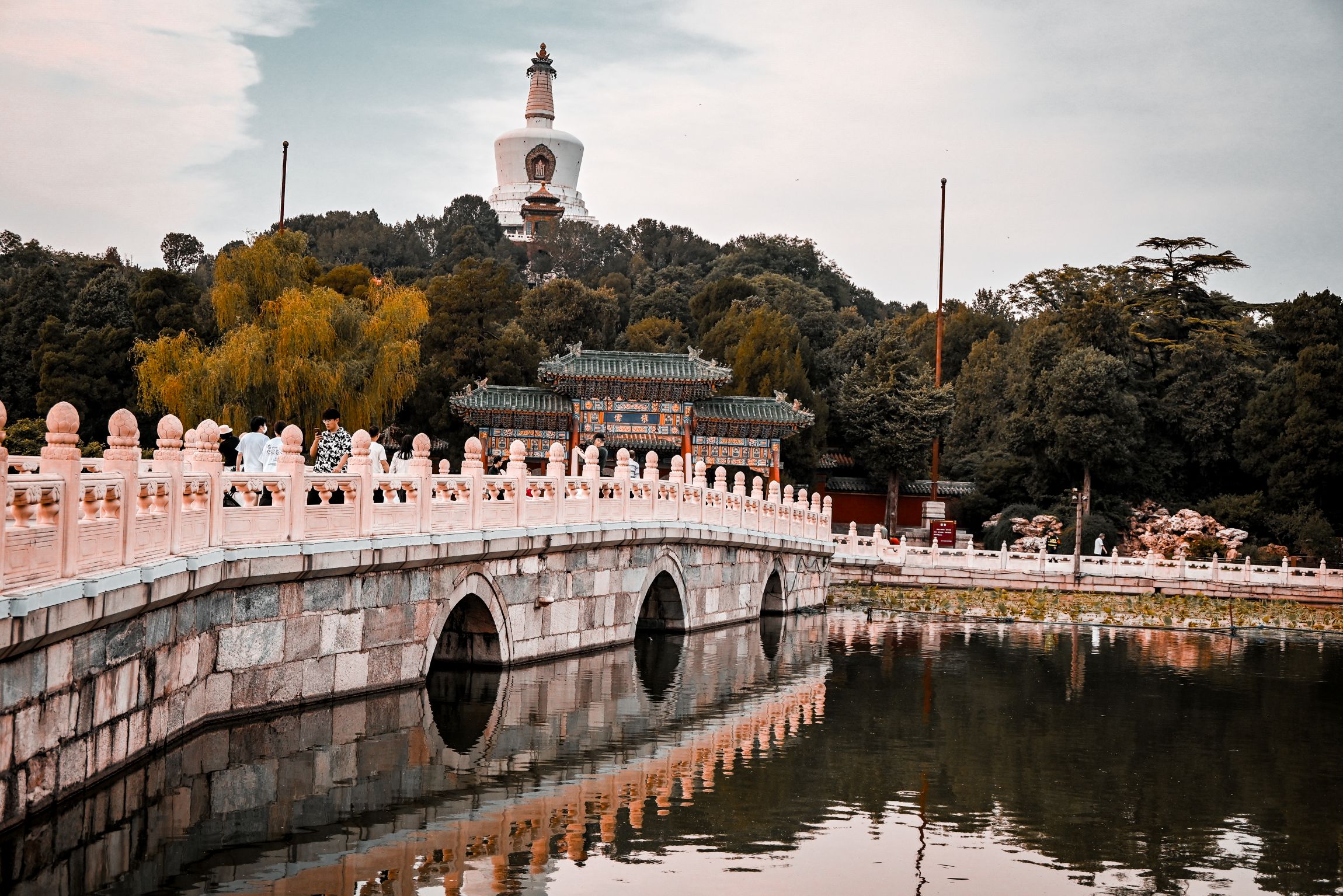
Just northwest of the Forbidden City, Beihai Park was once part of the emperor’s private playground, dating back over a thousand years. Today, it’s a serene escape from the city’s buzz, where locals practice Tai Chi beneath ancient cypress trees and paddle boats drift across a shimmering lake.

At the heart of the park lies Jade Flower Island, crowned by the iconic White Dagoba—a Tibetan-style stupa that gleams against the sky. From its summit, you get sweeping views of Beijing’s skyline and the lake below, which covers more than half the park’s 70 hectares. The design draws inspiration from legendary Chinese landscapes, blending natural elements with pavilions, temples, and winding corridors that feel like scenes from a scroll painting.
Don’t miss the Nine-Dragon Wall, a dazzling stretch of glazed tiles depicting—yes—nine writhing dragons in vivid color. It’s one of only three such walls in China and a favorite photo spot. And if you’re after a quiet moment, the Circular City near the south gate offers a peaceful courtyard and a centuries-old jade vase once treasured by emperors.


General Park Hours:
- April 1 – October 31: 6:00 AM – 9:00 PM (last entry at 8:30 PM)
- November 1 – March 31: 6:30 AM – 8:00 PM (last entry at 7:30 PM)
Scenic Spots and Courtyards (like Jade Island and the Nine-Dragon Wall):
- April 1 – October 31: 8:00 AM – 6:00 PM (last entry at 5:30 PM)
- November 1 – March 31: 8:30 AM – 5:00 PM (last entry at 4:30 PM)
Note: Most scenic spots are closed on Mondays, except during public holidays.
Tickets here: https://gyg.me/MVepOCGN
Jingshan park
Let’s climb to the crown of Beijing—Jingshan Park, where history meets skyline in one sweeping panorama.

Perched directly north of the Forbidden City, Jingshan Park was once the imperial garden of the Yuan, Ming, and Qing dynasties. Its central hill, built from the earth excavated to create the palace moats, is the highest point in old Beijing. From the summit’s Wanchun Pavilion, you get a postcard-perfect view: the golden rooftops of the Forbidden City stretching south, the Bell and Drum Towers to the north, and Beihai Park’s shimmering lake to the west.

The park itself is a peaceful blend of cypress groves, winding paths, and five pavilions—each once home to a copper Buddha representing one of the five tastes: sour, bitter, sweet, acrid, and salty. Locals gather here at dawn to sing, dance, and practice Tai Chi, while visitors climb the hill for that iconic cityscape shot.
Beijing Hutongs
Let’s slip into the narrow alleys of Beijing’s hutongs—where the soul of the city hums quietly between grey brick walls and red lanterns.
Hutongs are centuries-old alleyways that thread through the city’s historic core, originally laid out during the Yuan Dynasty. Lined with siheyuan—traditional courtyard homes—they form a living maze of community life, where neighbours chat over tea, laundry flutters from windows, and the scent of home-cooked dumplings drifts through the air.


Unlike the grandeur of the Forbidden City or the symmetry of the Temple of Heaven, hutongs are intimate and human-scaled. They’re where Beijing breathes. Some, like Nanluoguxiang or Dashilan have become trendy with cafés and boutiques, while others remain wonderfully untouched, offering glimpses into daily life that hasn’t changed much in decades.
There’s even a saying: “There are more hutongs in Beijing than hairs on an ox.” That’s how deeply they’re woven into the city’s fabric.
Modern Beijing
But Beijing is not just about the past. It is a sprawling modern city with awe inspiring architecture and superb shopping.
For an incredible shopping experience, head to Wangfujing.
Located in Beijing’s Dongcheng District, it’s one of the city’s most iconic shopping streets, blending centuries of history with modern flair.


🚇 Getting There: Take Subway Line 1 to Wangfujing Station, Exit A leads straight to the action
🧭 What Makes It Special
- 700+ Years of History: The name “Wangfujing” means “princely mansion well”, a nod to the eight royal residences and a sweet-water well that once graced the area
- Cultural Fusion: From luxury malls to traditional silk shops, it’s a microcosm of Beijing’s evolution.
- The Cheesecake Factory: Yes, it is a western café, but their cheesecakes are AMAZING!
- Anime: if you are into anime, check Soshow shopping centre for anything anime!
Sanlitun: Beijing’s Playground of Fashion, Food & Nightlife
And don’t miss a night (or more) in Sanlitun:
📍 Location: Chaoyang District, northeast Beijing
🚇 Getting There: Take Subway Line 10 to Tuanjiehu Station, then walk ~10 minutes
Over 80 bars line this legendary strip, offering everything from rooftop cocktails to live music and themed events
Shopping Highlights
- Taikoo Li South: Street fashion, quirky boutiques, and creative luxury brands
- Taikoo Li North: High-end designer labels like Emporio Armani, Longchamp, and Rolex
- Sanlitun SOHO: Sleek architecture and upscale retail designed by Kengo Kuma
🍽️ Foodie Finds
- Nali Patio: A hidden courtyard with international restaurants and wine bars
- Topwin Center: Trendy dining spots with rooftop views
- CHAO Hotel: Award-winning urban lifestyle hotel with curated art and cuisine


However, there is a lot more to see.
Temples abound, the little quiet kinds where silence and meditation take the central spot; palaces creep out and beg to be visited; parks dot the city and they are oasis of calmness.
There are several parts of the Great Wall easily reachable from Beijing and there are many tours available.
If you want to explore further afield, I highly recommend these three hidden gems a short distance from Beijing and easily reachable by DIDI or by bullet train. They are virtually unknown to international tourism and they are absolutely, incredibly stunning!!
Read on!
Beijing Watertown
Chengde
Datong