Venice Diaries: Ode to the Floating City
Where do you even start when talking about Venice?
Eternal, unique, crowded, expensive, posh, crass, overrated and underrated, Venice is everything and its opposite.
Love it or hate it, it’s a city like no other.
With its enchanting canals, historic architecture, and vibrant culture, Venice is capable of charming you for life.
I have been several times and I love it every time. Venice is one of my absolute favourite places in the whole world.

Venice, known as Venezia in Italian, lies on a lagoon in northern Italy along the Adriatic Sea. It stands on 118 small islands, separated by canals and connected by 438 bridges. The historic center comprises six districts, or sestieri: Cannaregio, Castello, Dorsoduro, San Marco, San Polo, and Santa Croce.
How to get there
Venice offers easy access by flight from numerous international and domestic airports and boasts strong train connections to many European cities.
Please note that the train will have its final stop at Mestre station, on the mainland, but there are shuttles or a smooth, 10 minutes local train ride into Venice.
There are also several cruises that depart or stop in Venice.
A bit of history
Venice’s origins date back to the 6th century when refugees fleeing from Germanic invasions sought refuge on the islands of the Venetian Lagoon. The city was officially founded in 697 AD.
By the 9th century, Venice had become a significant trading hub, connecting the East and West. Its strategic location made it a crucial player in the Mediterranean trade routes. The city’s wealth grew, and it gained independence from the Byzantine Empire in 1082.

The Republic of Venice
In 1143, Venice was first referred to as a “commune,” and by the 12th century, it had established itself as a powerful maritime republic. The Doge, elected for life by the Great Council, was the head of state. Venice expanded its territories, controlling parts of modern-day Italy, Slovenia, Croatia, Montenegro, Albania, Greece, and Cyprus.
Decline and Fall
Venice’s decline began in the 15th century as new trade routes opened up in the Atlantic, reducing its importance as a trade centre. The city faced several challenges, including the Black Death, wars with the Ottoman Empire, and the eventual conquest by Napoleon in 1797, which marked the end of the Republic of Venice.
Modern Era
After Napoleon’s defeat, Venice came under Austrian rule, until it became part of Italy in 1866.
Top Attractions in Venice
St. Mark’s Basilica: A stunning example of Byzantine architecture, located in Piazza San Marco. Also known as Basilica di San Marco, the cathedral church of the Patriarchate of Venice honors Saint Mark the Evangelist, the city’s patron saint. Its Byzantine, Romanesque, and Gothic architectural styles, along with its magnificent golden mosaics and intricate sculptures, earn it widespread renown.

Doge’s Palace: The Doge’s Palace (Palazzo Ducale) is one of Venice’s most iconic landmarks. It was the residence of the Doge, the elected leader of the Republic of Venice, and served as the seat of Venice’s government. The palace is a stunning example of Venetian Gothic architecture and houses a wealth of art and historical artifacts.


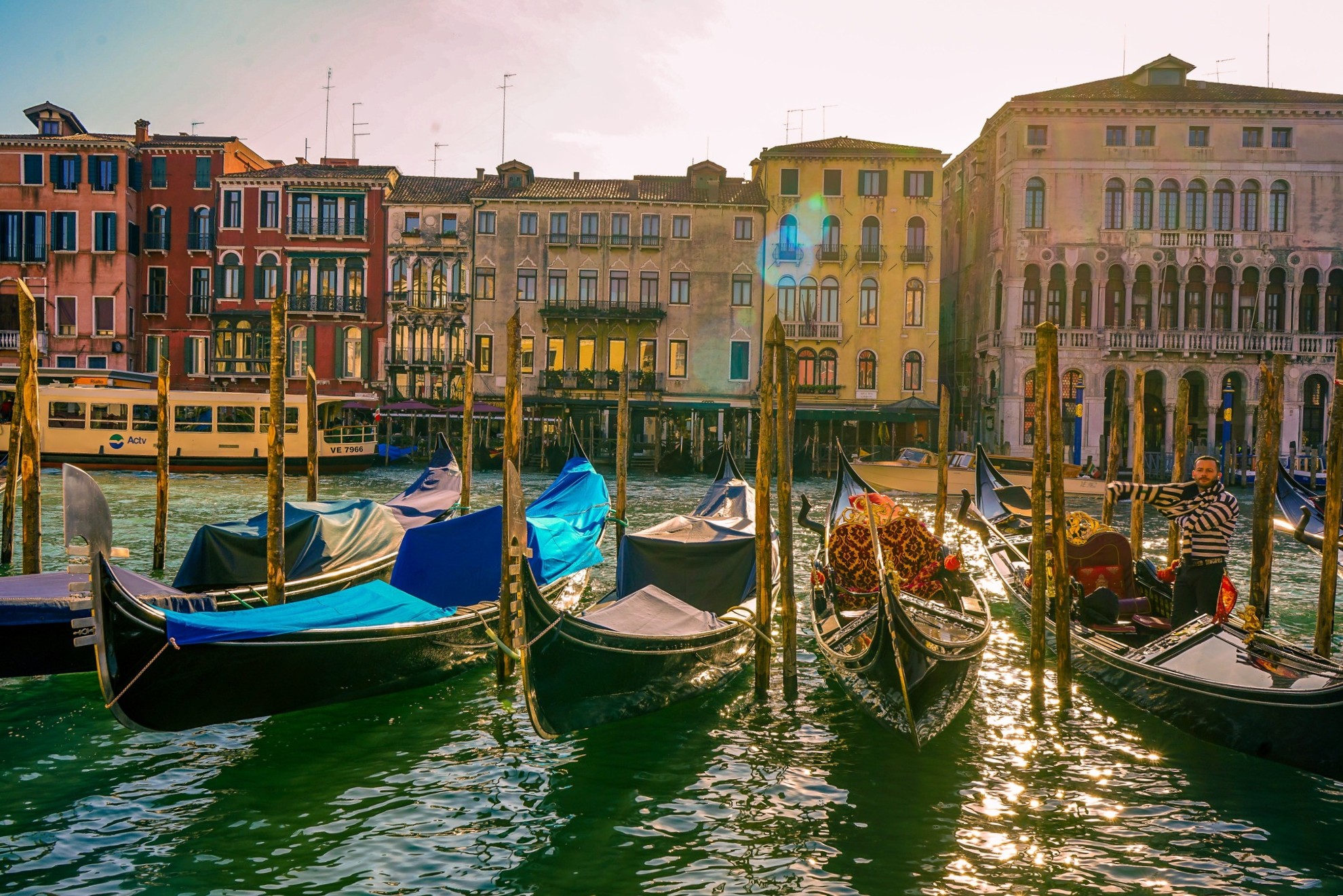
Grand Canal: The main waterway of Venice, perfect for a gondola ride or a vaporetto (water bus) tour. The Grand Canal, or “Canal Grande” in Italian, is a beautiful, winding canal that snakes through the heart of the city, offering stunning views of historic palaces, churches, and bridges.
The canal is a bustling hub of activity, with gondolas, vaporetti and private boats going about and a great place for people watching.

Rialto Bridge: One of the most iconic bridges crossing the Grand Canal, offering great views and bustling markets. Ponte di Rialto, is also one of Venice’s oldest bridges. Spanning the Grand Canal, it was completed in 1591 and designed by Antonio da Ponte. This elegant stone arch bridge is renowned for its harmonious design and stunning views of Venice.
The Rialto Bridge not only serves as a vital connection between the districts of San Marco and San Polo but also stands as a testament to Venice’s architectural ingenuity and historical significance. It’s a must-see for anyone exploring the enchanting streets and canals of Venice.

Things to Do in Venice
Gondola Ride (or ferry)
If you can afford it (it’s expensive), experience Venice from the water with a traditional gondola ride along the canals. Otherwise, there is a much cheaper alternative: hop on the public ferry at any of the stops and do a full loop, it’s still a very good experience!

Admire the Gran Canal from Ponte dell’ Accademia
The Ponte dell’Accademia is one of only four bridges that span the Grand Canal in Venice. It connects the sestiere (district) of Dorsoduro with the sestiere of San Marco, near the Gallerie dell’Accademia, from which it takes its name.
The current bridge is made of wood and steel, designed in 1933 by Eugenio Miozzi. The structure has been rebuilt and restored several times over the centuries, with earlier versions made of iron and wood. The bridge offers stunning views of the Grand Canal and the Basilica di Santa Maria della Salute. It’s a popular spot for both tourists and photographers.

Explore the outer islands
If you have time, make sure to visit Venice’s surroundings islands, which are very easy to get to.
My two personal favourites are:
Burano:
Burano is a picturesque island in the Venetian Lagoon, known for its vibrant, colourful houses and rich history. Just a 45-minute ferryboat ride from Venice, Burano is a popular day trip destination.
The island’s brightly painted homes create a stunning visual display along the canals, earning it widespread fame.


Burano has also a long tradition of lace-making, and you can visit the Museo del Merletto (Lace Museum) to see beautiful lacework and learn about the craft.
Giudecca Island
It’s a serene and picturesque island located in the Venetian Lagoon, just south of Venice and easily reachable by inexpensive public water taxis just across the bay.
Giudecca lies immediately south of the central islands of Venice, separated by the Giudecca Canal. It’s part of the Dorsoduro district.
In ancient times, the island was called Spinalunga (“Long Thorn”). The name Giudecca may derive from “Judaica,” reflecting its historical Jewish population that used to live on the island.


Giudecca is home to several beautiful churches, including the Palladio-designed Il Redentore. The island also features the historic Molino Stucky, a former flour mill now converted into a luxury hotel.
Unlike the bustling streets of Venice, Giudecca offers a relaxed escape with fewer tourists and a more stress-free vibe and stunning views towards Venice!
Enjoy Aperitivo: Join the locals for an aperitivo at a local bar, an Italian tradition of enjoying drinks and snacks before dinner.

Best Time to Visit
Avoid the summer. It’s overcrowded, especially with cruisers, stifling hot, expensive and a little smelly due to the stagnant water in the heat.
- Spring (April to June): Mild weather and fewer tourists.
- Autumn (September to November): Pleasant temperatures and fewer crowds.

Getting Around
- On Foot: explore Venice on foot, allowing you to discover hidden alleys and charming squares.
- Vaporetto: Use the public water buses to navigate the canals and reach different parts of the city.
Respect the Environment: Be mindful of the delicate ecosystem of Venice and avoid littering or damaging the historic structures.


Please note, starting from April 25, 2024, there will be a fee to visit Venice. The Venice Access Fee is €5 per person per day for tourists who are not staying overnight and want to visit between 8:30 AM and 4:00 PM on specific “black-sticker” days to combat overtourism and support sustainable tourism.
- Fee: €5 per person per day if you are not staying overnight in Venice, mostly day cruisers.
- Dates: Applies on specific “black-sticker” days, such as weekends and holidays from April 25 to July 14, 2024.
- Exemptions: Residents, students, commuter workers, and those staying overnight in Venice do not need to pay.
- Free Access: Access is free between 4:00 PM and 8:30 AM, and for smaller islands like Murano and Burano