Palermo Uncovered: A Guide from a Local
Palermo is a vibrant and historic city and the capital of the island of Sicily, Italy, in the middle of the Mediterranean sea.
The city has a rich and diverse history that spans thousands of years.
Brief history
- Phoenician Settlement: Around the 8th century BCE, Phoenician traders established a settlement in Palermo, which they called Ziz. It became an important trading hub.
- Greek Influence: The Greeks later colonized the area, renaming it Panormos. They coexisted with the Phoenicians until the Roman conquest.
Roman and Byzantine Periods
- Roman Conquest: Palermo was captured by the Romans in 254 BCE and became known as Panormus. It flourished under Roman rule, becoming a significant city in the empire.
- Byzantine Rule: After the fall of the Western Roman Empire, Palermo came under Byzantine control in 535 CE. The Byzantines fortified the city and maintained its prosperity.

Arab and Norman Eras
- Arab Conquest: In 831 CE, the Arabs conquered Palermo, transforming it into a thriving centre of trade with North Africa. The city experienced a golden age under Arab rule.
- Norman Rule: In 1072, the Normans, led by Roger I and Robert Guiscard, took control of Palermo. The Norman era (1072-1194) was marked by cultural and architectural achievements, with Palermo becoming the capital of the Kingdom of Sicily.
Later Periods
- Hohenstaufen Dynasty: After the Normans, the German Hohenstaufen dynasty ruled Palermo, with Emperor Frederick II making it a cultural centre.
- Spanish Rule: Palermo came under Spanish control in the late 15th century and remained so until 1860.
- Italian Unification: In 1860, Giuseppe Garibaldi seized Palermo, and it became part of the unified Kingdom of Italy.
Palermo, and the whole island of Sicily, has such a varied history and that is reflected into pretty much everything in our culture: from our ancient traditions, to architecture to food.

Don’t miss:
The Palermo Cathedral (Cattedrale di Palermo) is a stunning architectural marvel with a rich history. It was built starting in 1185 by the Norman Archbishop Gualtiero Offamilio on the site of an earlier Byzantine basilica. Interestingly enough, it was once converted into a mosque and some typical Islamic features can still be seen like the 5 pillars of Islam at the entrance.

The cathedral features a mix of Norman, Gothic, Baroque, and Neoclassical styles due to various additions and restorations over the centuries.
It houses the Royal and Imperial Tombs of notable figures such as Roger II, Henry VI of Swabia, Constance of Altavilla, and Frederick II of Swabia.


Don’t miss the chance to visit the rooftop for sweeping views over the city.
If you want to know more about Palermo from the rooftop, here is a blog post I specifically made with an interesting itinerary https://blog.worldswithout.net/palermo-itinerary/

Visiting Information
- Address: Via dell’Incoronazione 4, Palermo, PA, 90134
- Opening Hours: Monday to Saturday from 7:00 AM to 7:00 PM, and Sunday from 8:00 AM to 1:00 PM and 4:00 PM to 7:00 PM.
- Admission: Entry to the cathedral is free, but there is a ticket to access the monumental area, including the royal tombs, treasury, crypt, and roof.
Norman Palace (Palazzo dei Normanni)
Norman Palace (Palazzo dei Normanni): Once the seat of the Norman kings, it now houses the Sicilian Parliament. The palace was originally a Norman castle built after the Normans conquered Sicily in 1072. It became the main residence of the Norman kings.
Don’t miss the Cappella Palatina, added in 1132 by King Roger II, a stunning example of Arab-Norman-Byzantine architecture. The chapel is renowned for its glittering Byzantine mosaics and is considered one of the finest examples of medieval architecture.
Here you will see the first of the four golden mosaics representing Christos Pantocrator (creator of all) that surround the Palermo area.


Royal Apartments: The palace contains the private apartments of the Sicilian royal families, with rooms decorated in various styles reflecting different historical periods.
Visiting Information
- Address: Indipendenza Square, 1, Palermo, Palermo, 90129
- Opening Hours: Monday to Saturday from 9:00 AM to 5:00 PM, and Sunday from 9:00 AM to 1:00 PM.
- Admission: The entrance fee is around €12 per person. It’s recommended to book tickets in advance to avoid long lines.
Vucciria and Ballaro’ Market: Two bustling markets known for its lively atmosphere and diverse array of fresh produce, spices, and street food. They have been operational since Moorish times and it offers a good insight into Sicilian way of life.


Palermo’s Baroque churches
Palermo is home to a remarkable number of churches, reflecting its rich religious and architectural heritage. While it’s difficult to provide an exact count due to the many small chapels and lesser-known churches, there are over 100 churches in Palermo, ranging from grand cathedrals to quaint parish churches, which differ in architectonic style.


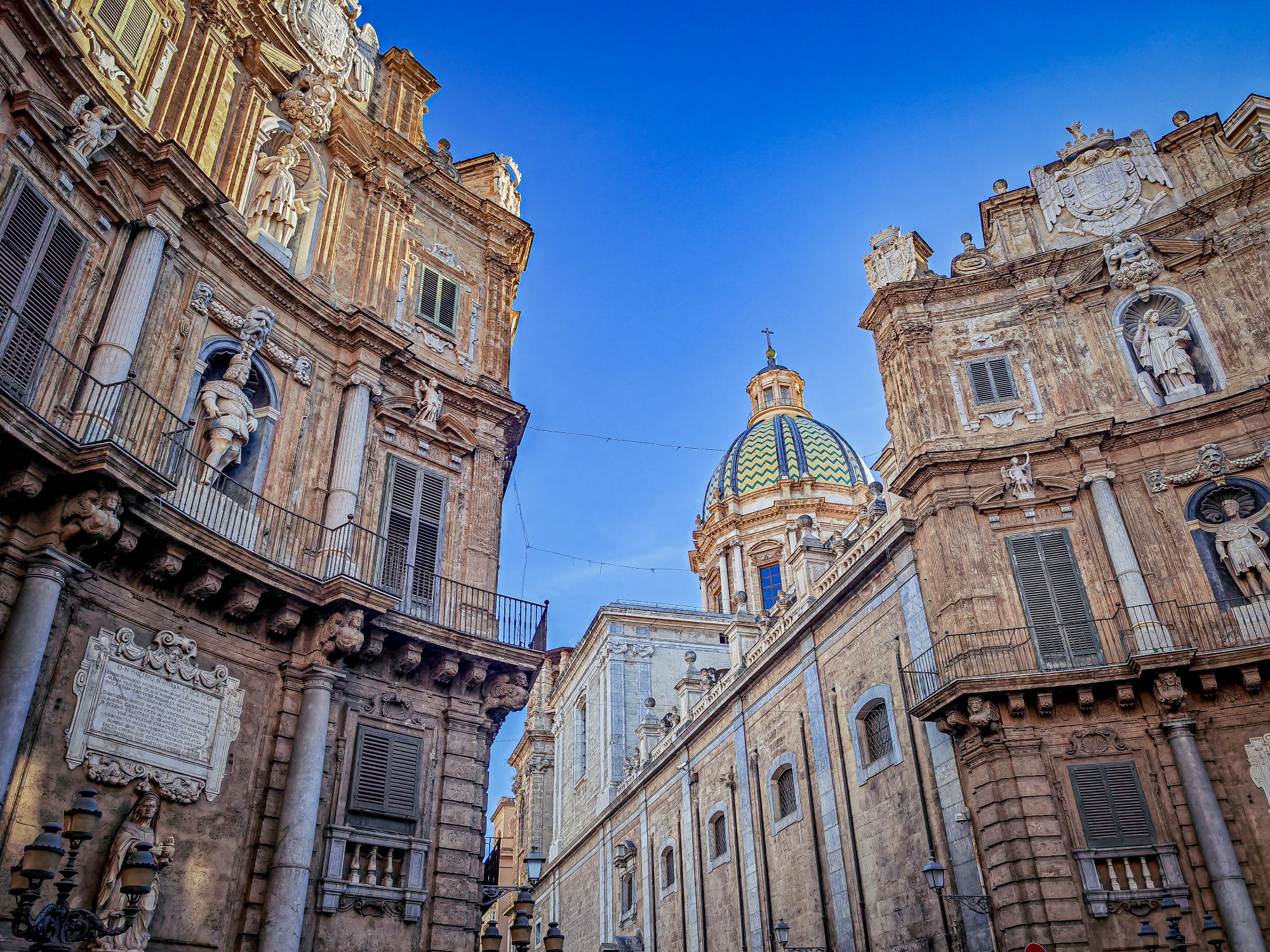
Two of the most beautiful churches in Baroque style, and that absolutely deserve a visit, are Chiesa del Gesu’ di Casa Professa and Chiesa di Santa Caterina d’Alessandria, quite close to each other.
Casa Professa was built by the Jesuits starting in 1564, and it was completed in 1683 with the addition of the dome. The interior is grand and opulent, featuring a Latin cross layout with three naves and deep side chapels. The walls and ceilings are adorned with intricate stucco decorations by Procopio Serpotta.

Visiting Information
- Address: Piazza Casa Professa 21, Palermo, Sicily
- Opening Hours: Monday to Saturday from 9:30 AM to 4:30 PM (extended to 6:30 PM in summer), and Sunday for mass only.
- Admission: Ticket prices are €5 for full access and €2 for access to the chapels and side naves.
The church of Santa Caterina d’ Alessandria was founded in 1310 by Benvenuta Mastrangelo, who endowed the foundation of a female Dominican convent. Over the centuries, the church has undergone several renovations, incorporating elements of Renaissance, Baroque, and Rococo styles.
The interior is richly decorated with stucco details, statues, coloured marbles, frescoes, and paintings. It is possible to visit the exquisite cloister with annexed Nuns’ bakery and the rooftop for the most stunning views of Palermo.


This church is my favourite and it is still largely unknown by mass tourism.
If you want to know more about this church and Palermo from the rooftops, take a look here https://blog.worldswithout.net/palermo-itinerary/

Visiting Information
- Address: Piazza Bellini 1, Palermo, Sicily
- Opening Hours: Monday to Saturday from 10:00 AM to 6:00 PM, and Sunday from 10:00 AM to 1:00 PM.
- Admission: Entry is free, but there is a fee for the rooftop.
Moorish/Aragonese heritage churches
Palermo is home to several stunning churches that showcase the Moorish and Aragonese influences in their architecture.
San Giovanni degli Eremiti: This church is a prime example of Arab-Norman architecture, featuring red domes and a cloister with Moorish arches. It was originally built in the 6th century and later transformed by the Normans in the 12th century.


La Martorana (Santa Maria dell’Ammiraglio): Known for its beautiful mosaics and Arab-Norman style, this church was founded in 1143 by George of Antioch, the admiral of King Roger II. The interior is adorned with stunning Byzantine mosaics and Islamic-inspired decorations.
Here you will see the second golden mosaic of Christos Pantocrator.

San Cataldo: Located next to La Martorana, this church is another example of Arab-Norman architecture. It features distinctive red domes and a simple yet elegant design that reflects the Moorish influence.

La Zisa
La Zisa is a magnificent 12th-century Norman palace located in Palermo.
Built between 1165 and 1189 by Arab craftsmen under the rule of King William I and completed under King William II, La Zisa was designed as a summer residence for the Norman kings. The name “Zisa” derives from the Arabic term “al-ʿAzīza,” meaning “the Dear one” or “the Splendid one”.


The palace showcases a blend of Islamic and Norman architectural styles. Notable features include the muqarnas (honeycomb vaulting) over the doors, the Sala della Fontana (Hall of the Fountain) with its pointed cross-vaulted ceiling, and the intricate geometric designs.
La Zisa is yet another testament to the rich cultural and architectural heritage of Palermo, reflecting the city’s historical connections with both the Moorish and Norman influences.
La Zisa is located at Piazza Zisa, 90135 Palermo.
The palace is open to visitors from Tuesday to Sunday, with opening hours from 9:00 AM to 5:00 PM. The last entry is at 4:30 PM.
Teatro Massimo and Teatro Politeama
They are two of Palermo’s most important and iconic theatres, each with its own unique charm and history.
Teatro Massimo
Location: Piazza Verdi, Palermo.
Teatro Massimo is the largest opera house in the whole of Italy and one of the largest in Europe. It is renowned for its perfect acoustics and grand architecture.
Opened in 1897, the theatre was designed by Giovanni Battista Filippo Basile and completed by his son, Ernesto Basile. It was dedicated to King Victor Emanuel II.
The exterior features a neoclassical style with influences from Greek Sicilian temples, while the interiors are art-nouveau. The theatre can seat over 1,300 people and hosts more than 130 music, opera, and dance events every year.

Teatro Politeama
Location: Piazza Ruggero Settimo, Palermo.
Teatro Politeama, also known as Teatro Politeama Garibaldi, is the second most important theatre in Palermo. It houses the Orchestra Sinfonica Siciliana.
Giuseppe Damiani Almeyda designed the theatre, building it between 1865 and 1891. It opened its doors in 1874 with Vincenzo Bellini’s opera I Capuleti e i Montecchi.
The building is an important example of Neoclassical architecture. It features a large open-air amphitheatre, later transformed into a full-fledged theatre. The theatre was named after Giuseppe Garibaldi in 1882.

Palazzina Cinese
For something more exotic, head to the Palazzina Cinese, also known as the Chinese Palace, a fascinating historical landmark.
Architect Giuseppe Venanzio Marvuglia built the palace between 1799 and 1806 under the commission of King Ferdinand III of Sicily. It served as a royal residence for the House of Bourbon-Two Sicilies.
Designers created the palace in the Chinoiserie style, a trend that gained popularity in Europe during the 18th century.It features a blend of neoclassical and oriental elements, including pagoda-style roofs and intricate decorations.
Artists like Giuseppe Velazquez and Vincenzo Riolo adorned the palace’s interior with beautiful frescoes and paintings. The apartments span three floors, with the grand reception hall and the magical table room located on the ground floor.
The Palazzina Cinese is a unique and captivating example of the cultural exchange between Europe and the East, reflecting the eclectic tastes of the period.

The harbour and the new Molo Trapezoidale fountain
The city recently revitalized the Molo Trapezoidale, transforming it into a symbol of urban regeneration.
Location: Situated within the port of Palermo, the Molo Trapezoidale is part of the Palermo Marina Yachting area.
The area underwent significant redevelopment, transforming it into a modern and functional space while preserving its historical essence.
The Molo Trapezoidale now boasts a variety of amenities, including restaurants, cafes, and boutiques. It also features a large artificial lake with a dancing fountain that performs hourly shows with water, lights, and music.
Visitors can enjoy a picturesque promenade along the sea, offering stunning views of the Gulf of Palermo, Monte Pellegrino, and the Castello a Mare.


Day trips from Palermo
Mondello
Mondello is a charming seaside district of Palermo, Sicily, known for its stunning beaches and vibrant atmosphere. The shoulder seasons offer the best time to enjoy it, as the main summer months tend to be very busy.
Mondello boasts a number of Liberty-style villas and buildings, reflecting the early 20th-century trend of the garden city movement. These elegant structures add to the district’s unique charm.
Take the bus no. 806 from the city centre.

Monreale
A truly must see!
Monreale is a charming town located on the slope of Monte Caputo, just a short distance southwest of Palermo, Sicily.
Monreale Cathedral
The town is best known for its stunning Norman-Byzantine cathedral, which is part of the UNESCO World Heritage Site “Arab-Norman Palermo and the Cathedral Churches of Cefalù and Monreale.” The cathedral is renowned for its exquisite mosaics, which cover over 6,000 square meters and depict biblical scenes in vibrant colours.
Here is the third of the golden mosaics of Christos Pantocrator.

Cloister of the Cathedral: Adjacent to the cathedral is a beautiful cloister, featuring 228 intricately carved columns and a serene garden. The cloister is a masterpiece of medieval art and architecture.
King William II of Sicily founded Monreale in the 12th century. According to legend, the Virgin Mary appeared to him in a dream and revealed the location of a hidden treasure, which he used to build the cathedral.
Take the bus no. 389 from Piazza Indipendenza/ Palazzo Reale

Cefalù
Cefalù is a charming coastal town located on the northern coast of Sicily, about 70 kilometers east of Palermo.
The town has a rich history dating back to ancient times. The Greeks originally founded it, and it later thrived as an important Roman and Byzantine settlement. The town’s name originates from the Greek word “Kephaloidion,” which means “headland,” reflecting its prominent rocky promontory.
Cathedral: The town is best known for its stunning Norman cathedral, which is part of the UNESCO World Heritage Site “Arab-Norman Palermo and the Cathedral Churches of Cefalù and Monreale.” The cathedral, commissioned by King Roger II in the 12th century, features magnificent mosaics and a beautiful cloister.
Here is the fourth of the golden mosaics of Christos Pantocrator.

La Rocca is a towering limestone cliff dominates the town and offers breathtaking views of the surrounding area. Visitors can hike to the top to explore the ruins of an ancient castle and the Temple of Diana, a megalithic structure dating back to the 9th century BC.
Beaches: Cefalù boasts beautiful sandy beaches with crystal-clear waters, making it a popular destination for sunbathing and swimming. The town’s main beach, located near the historic centre, is particularly picturesque.

Medieval Streets: The town’s historic centre is a maze of narrow, cobblestone streets lined with charming shops, cafes, and restaurants. The medieval washhouse, known as “Lavatoio Medievale,” is a unique and well-preserved site worth visiting.
Local Cuisine: Cefalù offers a variety of delicious Sicilian dishes, including fresh seafood,pasta, and traditional pastries. Be sure to try the local specialty, “pasta alla Norma,” made with eggplant, tomatoes, and ricotta salata.
Easily reached by train from Palermo Centrale station.
Things to Do
Explore the Streets: Wander through the narrow, winding streets of the historic centre to discover charming squares, palaces, and churches.

Visit Museums: Check out the Palazzo Abatellis, which houses a collection of Sicilian art, and the Museum of Contemporary Art. The Archeaological museum is small but has some rare artefacts, like the Palermo Stone, a very important stele from Ancient Egypt that lists the kings of Egypt from the First Dynasty (c. 3150–2890 BCE) through to the early part of the Fifth Dynasty (c. 2392–2283 BCE).
Enjoy the Cuisine: Sicilian cuisine is different from the rest of Italy. Many civilizations have claimed Sicily as their home, shaping our food with influences from different cultures. Street food is everywhere in local markets and restaurants often specialise in traditional dishes rather than continental gastronomy.
Sicilian Food you need to try:
Arancina: our queen! Arancine are deep fried rice balls with different fillings. The traditional ones are Bolognese sauce or ham and cheese. But today there are several varieties, including vegan ones. The best place for alternative fillings is Ke Palle in Via Maqueda.


Panelle (vegan): our favourite junk/street food, panelle are deep-fried chickpea patties which can be eaten as a starter, snack or inside crusty bread. My favourite place is Nni Franco U Vastiddaru, at the bottom of Corso Vittorio Emanuele. This place has been there for decades and makes excellent panelle (and much more). There is usually a queue but it’s worth it. Not expensive at all. Alternatively you can try panelle at Passami ù coppu, at the junction between Corso Vittorio Emanuele and Via Roma.

Sfincione: also known as Sfincionello is a soft, high rise pizza. You can easily find it at the markets or in bakeries. Could be vegan, but some add anchovies, do ask.

Cannoli; one of our traditional desserts, they are deep fried crusty pastry tubes filled with sweet ricotta cheese. Nowadays there are several versions with chocolate fillings and some could be vegan.

Cassata Siciliana: our most traditional dessert and it’s a bomb of sugar, you have been warned! It’s a moist spongy cake, filled with ricotta cheese and topped up with a layer of marzipan and sweet candied fruits.

Melenzane alla Parmgiana: aubergines with tomato sauce and cheese
Caponata (vegan): one of our most traditional dishes, it’s a sweet and sour aubergine, celery and olives stew; eat it warm or cold.

Pane ca’ meusa: if you really want, Palermo’s street food offers also bread filled with cow’s spleen. You can find it at Nni Franco U Vastiddaru or Focacceria San Francesco. I have never tried, even before I became a vegetarian 30 years ago!
Fichi d’India (Prickly pears): our most beloved fruit! They are thorny fruits that you need to peel, you eat the inside flesh, including the little stones. You may not like it or find it weird, but give it a try! Please careful with the thorns and peel it! Or buy it peeled, if you are unsure on how to do it (there is a certain way).


Best Time to Visit
The best time to visit Palermo is from April to June or September to October when the weather is warm but not too hot, and the city is less crowded. Definitely avoid July and August as the weather is really boiling and the city congested.
Getting Around
- Public Transport: Palermo has an extensive bus network; purchase your tickets at kiosks or online. Do not expect the city buses to run on time! They’ll arrive… eventually.
Airport buses and connecting towns buses are run by private firms and are reliable.
- Walking: Many of the city’s attractions are within walking distance, making it easy to explore on foot.
- Taxis are available but they are a tad expensive
There are also horses and chariots, but please do not use them. The animals are poorly treated.


How about hiring a car?
I have heard this question many times. Palermo is a huge, busy, chaotic, congested city. Parking spaces are hard to come by and Sicilian driving style is “inventive” to say the least.
If you are planning to just stay in the city, you won’t need a car. It will be more of a hindrance than help.
Even if you are planning some day trips, most destinations are easily reachable by train and buses.
I would recommend hiring a car only if you are planning to travel around Sicily. And even so, I would hire the car just before moving out of Palermo.
Do not leave anything valuable inside the car and do take extra insurance.

Is it safe?
Palermo is generally safe, just take the normal precautions that you would anywhere.
People are usually very friendly, but please be wary of “too” friendly men.
As a Sicilian, please , Stop Glorifying The Mafia!
I have seen it so many times, foreigners coming, making jokes about the Mafia, wanting to see Corleone, buying the ubiquitous souvenirs with the moustached men and rifle, talking about the Mafia like it’s some kind of pageant. It may be something funny and folkloristic to you, but it is not to us.
The Mafia is a ruthless, criminal organization that has tortured and killed men, women and children. Has kidnapped, killed and bombed policemen, judges and journalists.
Has mercilessly killed people who stood up to them. These are the heroes that need celebrating.
We all carry the scars of what the Mafia has done, and continue to do, to our beautiful island. It is not a stupid, romanticised Hollywood film.
Sicily is not the Mafia and the Mafia is NOT Sicily!
We have millennia of history, of culture, of literature and these criminals won’t steal it.
Please, honour Sicily with its beauty and not a tragic side of our complicated history.
If you want to know more about the real face of Mafia and the stories of those who fought t, you can join a local tour which is very informative
https://www.addiopizzotravel.it/default.asp?p=vacanza&tour=17&hl=en