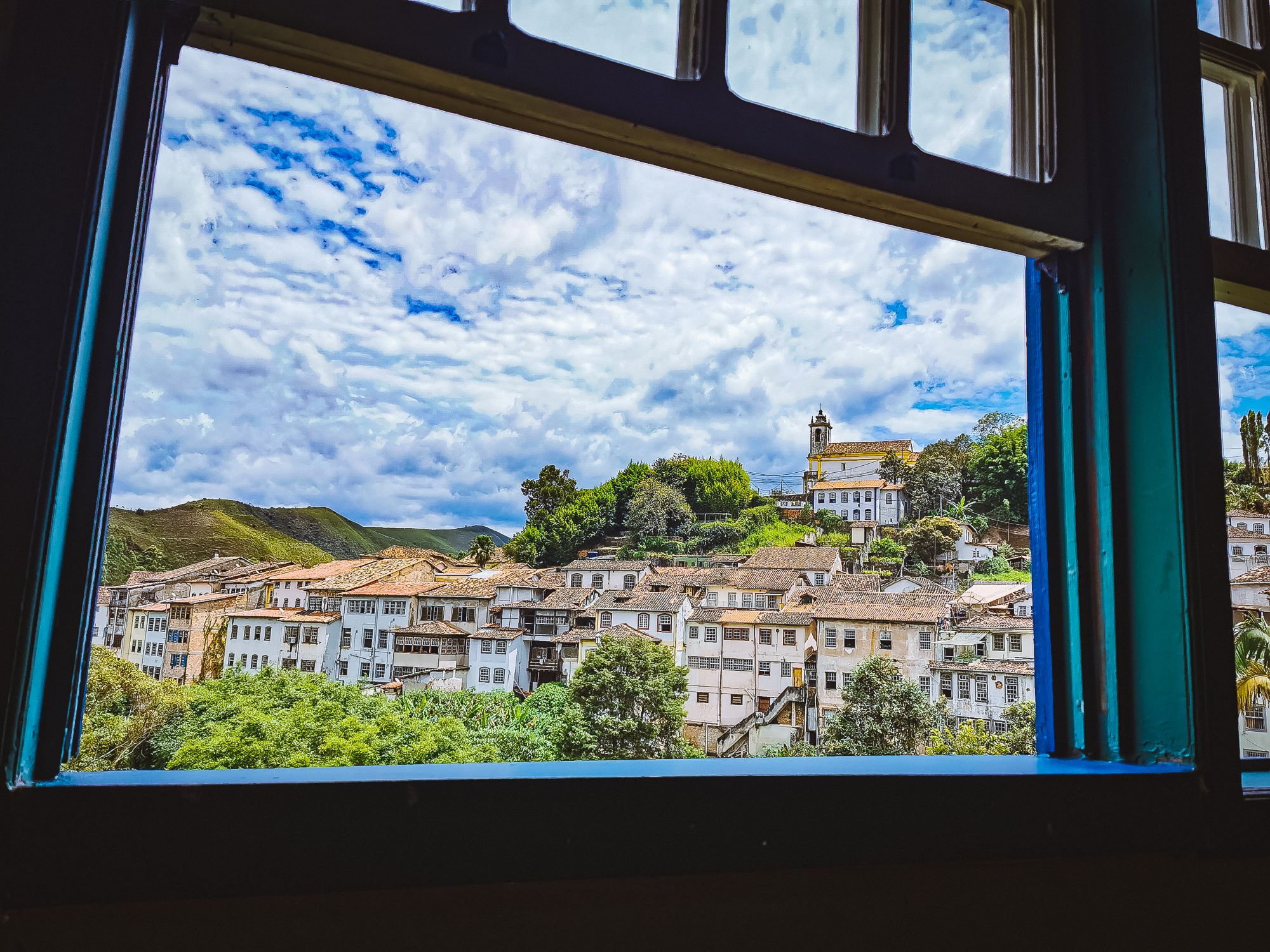
Ouro Preto, the city of gold
Snuggled in the heart of the Minas Gerais state, Ouro Preto, meaning black gold, was founded at the end of the 17th century, and was the focal point of the gold rush and Brazil’s golden age in the 18th century.
With the exhaustion of the gold mines in the 19th century, the city’s influence declined but many churches, bridges and fountains remain as a testimony to its past prosperity.

This UNESCO World Heritage site continues to captivate visitors with its baroque churches, cobblestone streets, and breathtaking landscapes.
The Historic City of Ouro Preto was also the symbolic centre of the Inconfidência Mineira in 1789, a Brazilian revolutionary independence movement and it is very interesting to learn its story.

How to get there
We flew from Rio de Janeiro into Belo Horizonte and arranged a private transfer with our hotel in OP. It was a very reasonable price and the driver was incredibly knowledgeable about the area.
So much we booked him for a tour. Unfortunately I misplaced his contact but any hotel would be able to arrange a driver.
Alternatively, you can hire a car at the airport and we found the journey not difficult at all to make. Driving time from the airport to Ouro Preto takes around 2 hours.
If you rather not drive, you could take the shuttle from the airport into Belo Horizonte and take the hourly bus from the Central bus station called Belo Horizonte Central. The bus journey should last around 2 hours.
You could also drive from Rio de Janeiro and it will take around 5 hours.

The town
As you wander through the narrow, winding streets of Ouro Preto, you’ll be transported back in time. The city is dotted with well-preserved colonial buildings that tell stories of the past.
Bring comfy shoes as the town is like a giant roller coaster.


Don’t miss a visit to Church of Saint Francis of Assisi (Igreja de São Francisco de Assis) designed by Antonio Francisco Lisboa, the son of the Portuguese architect Manoel Francisco Lisboa and an enslaved black woman named Isabel.


Antonio Francisco Lisboa is better known by the nickname Aleijadinho, meaning “The Little Cripple,” because he reportedly suffered from a chronic disease that left him disfigured. He is considered the greatest artist of colonial Brazil.
The church is stunning and the view is breathtaking!
Praca Tiradentes
Not far from there lies the expansive Praca Tiradentes and the Museu da Inconfidência, a museum dedicated to the casualties of the failed rebellion against Portugal in 1789, of which Joaquim Xavier, also known as Tiradentes, was one of its leaders.


Don’t miss the nearby Artisan market with beautiful pieces of sculpted marble and ceramics.
We bought nearly half of the market!
You can also visit several gold mines and listen to the stories about OP’s rich past.


Ouro Preto is not just about history; it’s alive with culture.
There is a vibrant local arts scene with numerous artisan shops and galleries. Here, you can find beautiful crafts, from hand-carved wooden pieces to exquisite jewellery. Be sure to engage with the local artisans, who are often eager to share their stories and techniques, providing a deeper understanding of the region’s artistic heritage. Some speak some English.

Savour the Flavors of Minas Gerais
No visit to Ouro Preto would be complete without indulging in the local cuisine. The region is famous for its delicious dishes, such as pão de queijo (cheese bread), feijão tropeiro (a hearty bean dish), and doce de leite (caramelized milk). Stop by a local restaurant or café to savour these culinary delights, and don’t forget to pair your meal with a glass of cachaça, Brazil’s beloved sugarcane spirit.

We tried a few restaurants and the food was always delicious.
We recommend: Restaurante Contos de Réis, Adega Ouro Preto, Restaurante Seu José
They have vegetarian options.

Ouro Preto is also surrounded by stunning natural landscapes.
At night, we could actually hear wolves howling in the mountains, it was a magical experience as I had never heard one before!
And speaking of nights, be warned: the temperature drops! I wondered why the hotel had woollen blankets on the bed, then I understood.
We arranged a tour with the driver that drove us from the airport.
I really wanted to visit the Andorinhas National Park and its beautiful waterfalls and we quickly realized that the lush Brazilian interior it’s just as stunning as its coasts, big blue butterflies everywhere and enormous termites nests.


He also took us to the small and cute village of Sao Bartolomeu, which really felt like being brought back into the past. There we met with the local community who explained to us the history of the village. Our Portuguese was not the best, but with our Spanish and Italian we understood enough.
It was an incredible day out which has left beautiful memories with us.


The whole state of Minas Gerais is stunning, with little colonial towns dotting the landscape: Mariana, Tiradentes, Sao Joao del Rei, Congonhas. There are waterfalls everywhere and beautiful, fertile hills.
The north of MG has many national parks with Serra da Canastra and the incredible waterfalls of Capitolio taking first place. We had no time to go on this trip, but we do plan to be back!

Check out our Brazil itinerary: our next stop, the three best beaches on Brazil’s north east coast.
For more Brazil blog posts: https://blog.worldswithout.net/brazil/