Myths, Marble, and Moussaka: Athens in Two Days
A weekend in Athens is perfect at any season!
Greece is my second (should I say third?) home and I love it viscerally, even before knowing that I had Greek ancestry. No where I feel more at home and relaxed than Greece and I love speaking Greek.
We’ve been to Athens quite a few times and I love it at any time of the year.
Athens is underrated and often overlooked but it is still a beautiful city to explore.
Often referred as the cradle of Western civilization, it offers a blend of ancient history, vibrant culture, and modern charm.
Brief history
One of the world’s oldest cities, it has a history spanning over 5,000 years. It became a dominant city-state in ancient Greece during the first millennium BCE. The city flourished in the 5th century BCE, known as the “Golden Age of Athens,” under leaders like Pericles, who oversaw the construction of iconic landmarks such as the Parthenon. After a period of decline during the early Middle Ages, Athens regained prominence under the Byzantine Empire and later prospered during the Crusades. However, it experienced a sharp decline under Ottoman rule before re-emerging in the 19th century as the capital of modern Greece.

A weekend in Athens’ itinerary is ideal to discover what the city has to offer.
Day 1
Start your day at the magnificent Acropolis that overlooks the city and marvel at the Parthenon and the Erechtheion.
A UNESCO World Heritage Site, this iconic landmark is a must-visit for its historical and architectural significance. The temple was constructed between 447 and 432 BCE during the “Golden Age of Athens” under the leadership of Pericles and it was dedicated to Athena Parthenos, the patron goddess of the city, whose colossal statue once stood within the temple.

The Acropolis of Athens is open daily with the following hours:
- Winter Season (November 1 – March 31): 08:00 – 17:00 (last entry at 16:30).
- Summer Season (April 1 – October 31): 08:00 – 20:00 (last entry at 19:30)2.
Keep in mind that the site is closed on certain holidays, such as January 1, March 25, May 1, Easter Sunday, December 25, and December 26
Tickets cost from 12.90 euro and can be purchased here: https://www.acropolis-tickets.com/acropolis-opening-hours/?form=MG0AV3&form=MG0AV3

From the Acropolis, walk down towards the charming area of Anafiotika, a quaint, Cycladic-style neighbourhood tucked beneath the Acropolis. It is an easy 13 minutes’ walk.


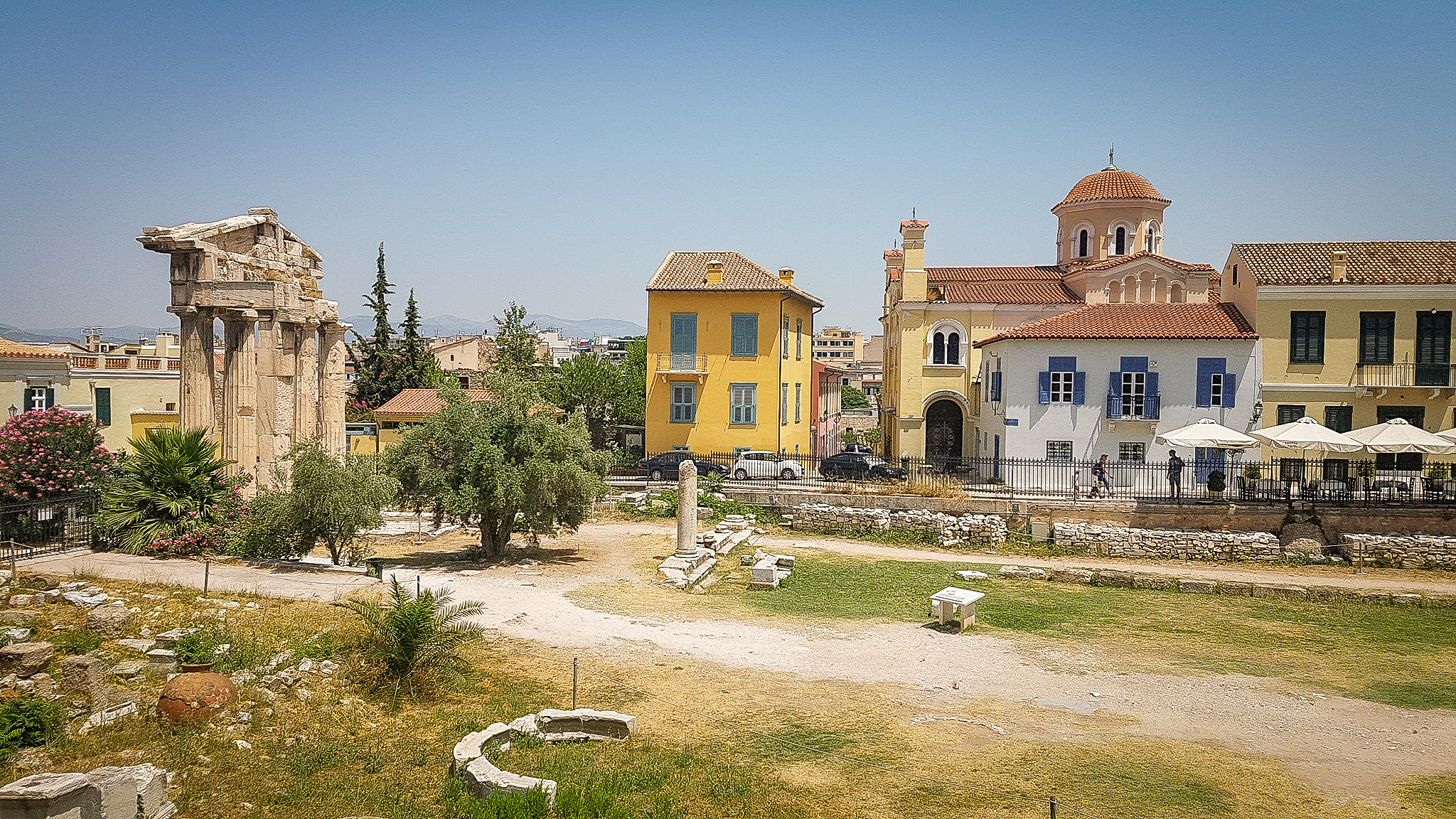
Another 7 minutes’ walk will bring you to the Roman Agora, the Hadrian’s library and the Athenian Agora in Monastiraki square.
Monastiraki is one of the liveliest squares in Athens and it’s great for people watching and grabbing something to eat/drink.


Day 2
Start the second day with a visit to Syntagma Square and the Greek government building. The changing of the guard is interesting to watch.

Another 10 minutes’ walk will bring you to the Athens National Garden and Zappeion Hall.
This place is virtually unknown to foreign tourists and it is one of my favourite spots in the city.
The Zappeion was the first building constructed specifically for the revival of the modern Olympic Games. It served as the main fencing hall during the 1896 Olympics and later as the press centre for the 2004 Games.


Another 10 minutes’ walk will bring you to the area of Plaka,a delightful neighbourhoodwith plenty of eating options, cafes and bars.


If you still have time, I would recommend a funicular trip (or hike) to Mount Lycabettus for panoramic views of the city.
If you are, like me, into archaeology and ancient history, a visit to the National Archaeological Museum is a must for an extensive collection of Greek artifacts.
Opening hours
November 1st – March 31st
Tuesday: 13:00 – 20:00
From Wednesday until Monday: 08:30 – 15:30
April 1st – October 31st
Tuesday: 13:00 – 20:00
From Wednesday to Monday: 08:00 – 20:00
Tickets: 12 Euro in high season, 6 euro in low season
You can purchase them here: https://www.namuseum.gr/en/

Local Cuisine
Don’t miss out on traditional Greek dishes, there is so much to choose from, including vegetarian and somewhat vegan.
Try Moussaka, a mince beef and aubergine baked dish; as a vegetarian I have found several places that offer vegetarian moussaka made with soya mince.
Souvlakis are meat skewers, could be beef, pork or chicken and they are offered everywhere.
Gyros are shreds of beef, kebab style, wrapped in soft pita bread, along with other ingredients such as tomato, onion, fried potatoes, and tzatziki. There is a vegetarian option or simply ask not to put the meat in.
Bouyourdi is baked feta with tomatoes, garlic and chilli as part of a meze lunch. It’s perfect for scooping up with warm pitta breads alongside a Greek salad.
Spanakopita, my favourite and I make my own at home. Literally it means spinach pie and it is exactly that, creamy ricotta and fresh herbs, then wrap them in crisp filo pastry.
Gemista are vegetables usually tomatoes, bell peppers, zucchini and eggplant filled with rice (sometimes with ground meat) and baked in the oven. Ask if you are not sure if they have meat in it or not.
For vegetarians, the starters are the best options. I usually end up ordering two or three starters or sides and there is plenty.


For dessert, the ever present Baklava, but also try Loukoumades (mini doughnut balls) or Portokalopita, an orange moisty spongy cake or Bougatsa, a custard filo pastry cake.
Don’t miss Little Kook, a popular, instagrammable, fairytale-inspired cafe offering sweet & savory crêpes & other treats. If you go at Christmas time, it is absolutely magical!

Practical Tips
- Transportation: The metro is efficient and connects major attractions. Walking is also a great way to explore the city.
- Best Time to Visit: Spring (April to June) and autumn (September to October) offer pleasant weather and fewer crowds.
- Language: While Greek is the official language, English is widely spoken in tourist areas.