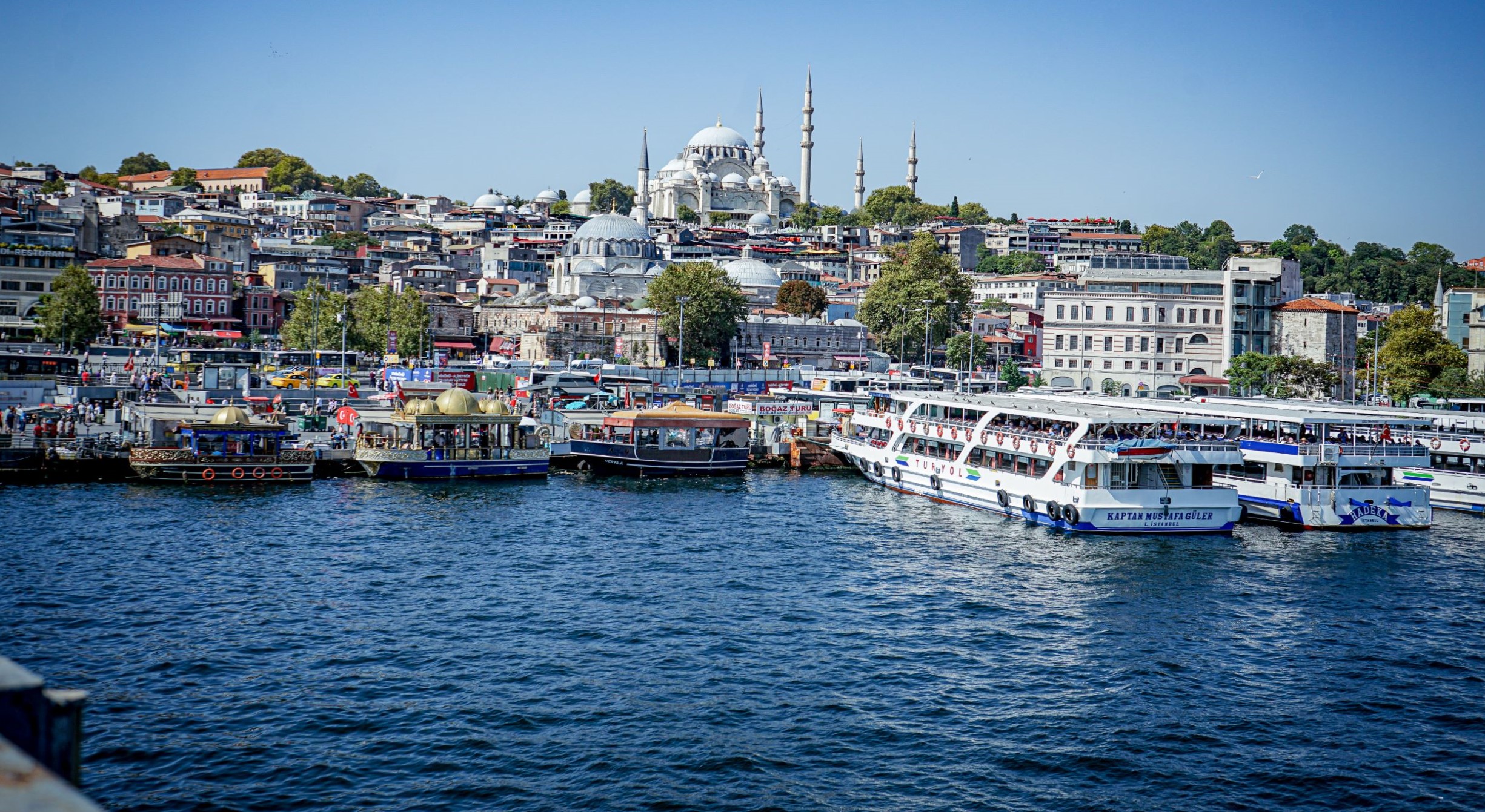
Istanbul: the bridge between East and West
Istanbul is a fascinating city.
Located in a strategical position between Europe and Asia, it has always been a key player in the trade routes and in the mingling of civilizations.
Contrary to what some believe, Istanbul is not Turkey’s capital. Ankara is.
But Istanbul is Turkey’s largest city and busiest port.
Getting there:
Just like in the old times, even today Istanbul is at the centre of the crossing between Europe and Asia which several flights stopping over.
Istanbul has two airports and it conveniently reached directly from many countries. Turkish Airlines is the national carrier and it is an outstanding company.


The city has a very rich history: Called Byzantium in ancient times, the city’s name was changed to Constantinople in 324 CE when it was rebuilt by the first Christian Roman Emperor, Constantine; Constantinopolis, from the Greek “city of Constantine”.
Again it was Greek speakers that gave Istanbul its modern name: they refer to trips to the city as eis tēn polin, “into the City,” rather than “to Constantinople.” By the 13th century this Greek phrase had become an appellation for the city: Istinpolin.
Through a series of language evolution over a span of centuries, this name became Istanbul.

The waters washing the peninsula are called “the three seas”: they are the Golden Horn, the Bosphorus, and the Sea of Marmara.
The Golden Horn
The Golden Horn is a deep drowned valley about 7 km long. The Bosporus is the channel connecting the Black Sea to the Mediterranean by way of the Sea of Marmara and the straits of the Dardanelles.
The broader Bosporus divides European Istanbul from the city’s districts on the Asian shore: Üsküdar and Kadıköy (ancient Chalcedon).

Fire, earthquakes, riots, and invasions have ravaged Istanbul many times, but her stubbornness to be reborn bigger and better, make her a Phoenix like city.
Just like Rome, the city is built on seven hills, their summits flattened through the ages but, unlike Rome, their slopes are still quite steep as you will find out, ascending and descending through the labyrinthine neighbourhoods.
Istanbul has three of the world’s longest suspension bridges: Bosporus I at 1,074 metres, Bosporus II (Fatih Sultan Mehmed Bridge) at 1,090 metres, and Bosporus III (Yavuz Sultan Selim Bridge) at 1,408 metres.


The Galata and Atatürk bridges cross the Golden Horn to Beyoğlu.
Once called Galata, it was an enclave for foreign traders, principally the Genoese, who enjoyed extraterritorial privileges behind their walls. After the Ottomans took the city in 1453, all foreigners who were not citizens of the empire were restricted to this quarter. The Galata district is dominated by a massive tower that shares its name. The tower was built by the Genoese traders in 1349 as a watchtower and a fortification for their walled enclave.

Beyoğlu and its core, İstiklal Avenue are lively , busy spots, and Taksim Square is perhaps the most central point in the city life. And superb shopping.


Basilica Cistern
Istanbul is famous for its underground cisterns, there are more than 80 remaining, not all open to public. One of the most beautiful and mysterious structures of Istanbul, the Basilica Cistern, possibly made even more popular by the Dan Brown’s book Inferno and the subsequent movie, is visitable. I strongly advise to buy your ticket online and still be prepared to queue.


Of the Byzantine period, not much is still existing, however the most enduring legacy from the capital of the vanished empire are its 25 Byzantine churches. Many of these are still in use as mosques. The largest of the churches is considered one of the great buildings of the world.
Hagia Sophia
This is Hagia Sophia, whose name means “Divine Wisdom.” Its contemporary and neighbour, St. Irene, was dedicated to “Divine Peace.”
The church is said to have been built by Constantine in 325 on the foundations of a possibly Greek temple and has been burned and rebuilt several times.

In 1453 it became a mosque with minarets, and the great chandelier was added. From 1935 to 2020 it functioned as a museum, with Islamic inscriptions hung from walls adorned with Christian mosaics. In 2020 it became a mosque again, and curtains were installed to conceal Christian iconography during communal prayers.
Just like the previous “owners” of the city, the new rulers loved the place as well and spent much of their treasure and resources on its enhancement. The Ottoman dynasty, which lasted from 1300 to 1922, continued to build new important structures almost until the end of their empire.
Probably the most popularly known of all the mosques in Istanbul is the Blue Mosque, the mosque of Ahmed I (Ottoman sultan from 1603 to 1617), which has six minarets instead of the customary four.

Topkapı Palace Museum
Topkapı Palace Museum exhibits the imperial collections of the Ottoman Empire and maintains an extensive collection of books and manuscripts in its library.
It is housed in a palace complex that served as the administrative centre and residence of the imperial Ottoman court from about 1478 to 1856.
There are several courtyards and the hareem buildings to visit and you can get a ticket package to visit the ones you prefer. Sadly, I lost all the pictures.
The Grand Bazaar
The Grand Bazaar (Kapalı Çarşı), was established in olden times but often subject to fire and earthquakes; it had 4,000 shops around two central distributing houses. It still is a focal point of modern Istanbul’s life. Open everyday 8.30 am to 7 pm.


Across the Bosphorus to the east is the Asian Side, are the historic districts of Kadıköy and Üsküdar. The Bosphorus and Marmara coasts are characterized by picturesque neighbourhoods, with a café and a pleasant park on its summit.


And if you love cats, you’re in for a treat!
Cats everywhere: Catstanbul lives up to its name, and has more than 125,000 purry, furry, feline citizens. They are seriously spoilt by Istanbul’s inhabitants. They provide food and water and there are little cute wooden houses on the streets built for them.


The best way to appreciate Istanbul’s bridges is a sunset Bosphorus cruise.
There are different options to choose from and some include dinner. Prices are very reasonable.
https://www.bosphorus-cruises.com

For a dinner to remember, with view over the Hagia Sophia, head to 360 Panorama restaurant. The food is very good, plenty of vegetarian options and the view is enchanting!


Istanbul is chaotic, hectic and multicultural. But this blend makes it unique. It is definitely a city to visit at least once and probably even more than once.

For more Turkey blog posts: https://blog.worldswithout.net/turkey/