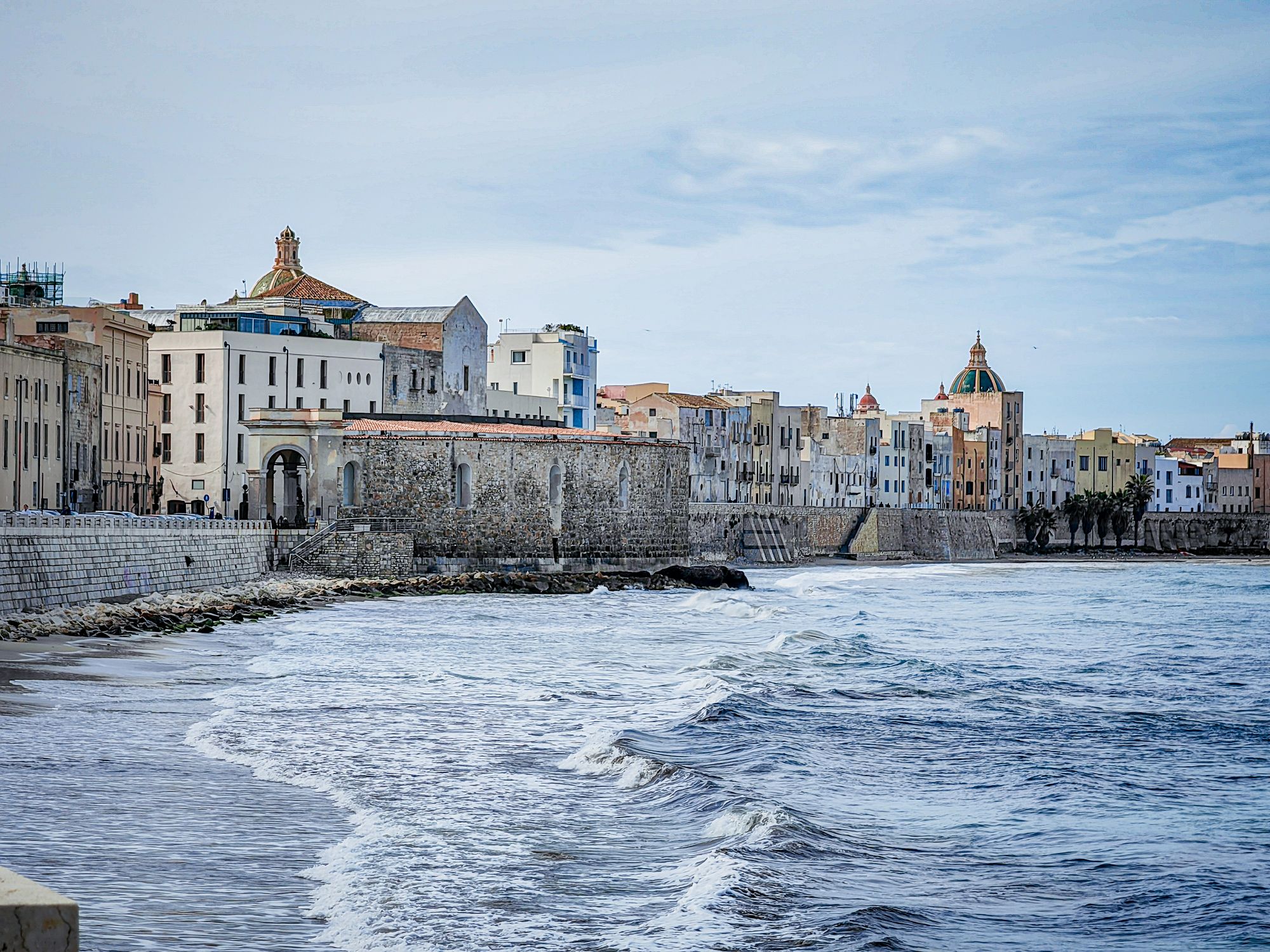
Insider’s Guide to Trapani and Western Sicily
Western Sicily is very much overlooked, compared to its more popular Eastern side.
Yet, it is equally stunning, more secluded and authentic, and less crowded (if you avoid the summer).
Trapani is the main city on the west coast of Sicily and it is a charming city with a rich history and plenty to offer to travellers.
It is easily reached by international and domestic flights or by ferry from some destinations.
Trapani, and Sicily at large, comes alive from spring to autumn and summer is definitely the best season; however, July and August are really too hot and too busy and I would not recommend.
Choose the shoulder months of June or September.

Brief history of the city
It was originally founded by the Elymians (presumably refugees from Troy and/or Greece) to serve as the port for the nearby city of Eryx (present-day Erice).
In 260 BC, Carthage seized control of the city, making it an important naval base. Most of our Western Sicily has deep Elymians/Phoenicians roots.
The city was ceded to Rome in 241 BC following the Battle of the Aegates in the First Punic War.
After the fall of the Roman Empire, Trapani experienced a period of decline but was later revitalized under Arab rule, which brought significant economic and cultural development.
In 1077, the Normans, led by Roger I, conquered Trapani, and the city flourished under their rule.
Trapani was heavily bombed by the Allies during World War II, causing significant damage to the city.
What to do in Trapani
Trapani is a city with beautiful architecture.
Explore the Baroque architecture, including the 14th-century Cattedrale di San Lorenzo, Palazzo della Giudecca, and Chiesa delle Anime Sante del Purgatorio.


Take a stroll at sunset at the Torre di Ligny: this historic tower built in 1671, now a museum, has some stunning views during the day and at sunset.

Good Friday procession: if you are in Trapani during Easter time, do not miss the Good Friday procession in the city centre. The Good Friday procession in Trapani, known as the Processione dei Misteri di Trapani, is one of the most significant and evocative Easter events in Sicily. This centuries-old tradition has been held every year since before 1612.

The procession lasts for at least 16 continuous hours, often extending beyond 24 hours. It features twenty lifelike sculptures made of wood, canvas, and glue, depicting scenes from the Passion of Christ. The procession starts at 2 PM on Good Friday, with the sacred groups making their solemn exit from the Church of Purgatory. The event has its roots in the Spanish domination of Sicily and was initially organized by a confraternity.
Do not miss the sunset at the salt pans!
The salt pans of Trapani are a fascinating blend of natural beauty and historical significance.

They date back to the time of the Phoenicians, who recognized the area’s potential for salt production due to its shallow coastal waters, strong sun, and steady winds.
The salt pans create a unique and picturesque landscape, especially at sunset when the colours reflect off the water.

The area is part of the Riserva Naturale Orientata delle Saline di Trapani e Paceco, managed by the WWF. It is a crucial habitat for many migratory birds, including flamingos, spoonbills, and egrets.
Visiting the Salt Pans
- Guided Tours: Various tours are available, including sunrise, morning, afternoon, and sunset tours, each offering a different perspective of the salt pans.
- Salt Museum: Learn about the traditional methods of salt extraction and the history of the salt pans at the local museum.
Sunset tours here: https://www.getyourguide.com/sicily-l65/trapani-salt-pans-sunset-tour-and-flamingo-way-t412063/?ranking_uuid=d4e396a0-d158-4090-9e22-fe27364a0167
Western Sicilian food:
Trapani is renowned for its fresh seafood. Don’t miss out on traditional dishes like seafood pasta and grilled fish.
Pesto alla Trapanese: Try this local dish, a unique twist on pesto made with almonds and tomatoes.
Couscous: western Sicily has a tradition of couscous, especially fish couscous. You will find it everywhere in Trapani which also hosts a Couscous Festival during the summer.
Beyond Trapani
The Egadi islands
Take a short ferry ride to the stunning Egadi Islands—Favignana, Levanzo and Marettimo. Favignana is the most popular, with incredible blue waters and stunning beaches.

You can book your tickets here: https://www.directferries.it/isole_egadi.htm
Alternatively, you can take a boat tour from Trapani: https://www.getyourguide.com/trapani-l1159/from-trapani-favignana-and-levanzo-boat-tour-with-lunch-t413394/?ranking_uuid=a1349658-1558-46bd-b011-804014a4d8f1
Erice
Erice is a captivating medieval hill town perched atop Monte San Giuliano, offering a blend of history, culture, and breathtaking views.
Originally founded by the Elymians and later influenced by the Phoenicians, Greeks, and Romans, the town flourished under Norman rule, with significant architectural contributions.

Must-See Attractions
Castello di Venere: Built by the Normans on the ruins of a temple dedicated to Venus, a fairytale-like castle carved into rock, providing panoramic vistas over Trapani and the Mediterranean.


Chiesa Madre: The main church, known for its impressive bell tower and historical significance.
Cobbled streets: Stroll along the labyrinthine little cobbled alleyways and stop at souvenir workshops (with incredibly beautiful traditional ceramic plates) and ice creams shops.
Getting There: Accessible via a scenic drive or a cable car ride from Trapani.
San Vito lo Capo
One of the most stunning beaches in Western Sicily. We call it the “Sicilian Caribbean”.
This long white sand beach is one of the best in Sicily, perfect for swimming, sunbathing, and snorkelling in crystal clear water. Avoid July and August as it is super crowded.


There is accommodation to suit any budget and plenty of restaurants. San Vito is known for its fish couscous.
Best reached by car at less than one hour drive from Trapani.
Otherwise, there are plenty of tours to get you there: https://www.getyourguide.co.uk/san-vito-lo-capo-l1611/
Segesta
My favourite place as a child and where I learn to drive!
Segesta was founded by the Elymians and has a rich history influenced by various civilizations, including the Greeks and Romans. The city was heavily Hellenized and became an important centre of Greek culture in Sicily.
Must-See Attractions
Doric Temple: This well-preserved temple, dating back to the 5th century BC, is one of the best examples of Doric architecture in the world.


Ancient Theatre: Located on Monte Barbaro, this Hellenic-era theatre offers stunning views of the surrounding countryside and is still used for performances today.
Archaeological Site: The site includes various ruins and artifacts that provide insight into the city’s ancient past.
You can reach Segesta by car from Trapani o Marsala, or by tour: https://www.getyourguide.co.uk/segesta-l2223/
Selinunte
Another gem of Western Sicily which is unknown by many.
Selinunte is an ancient Greek city located on the southwestern coast of Sicily, near the modern town of Castelvetrano. It is one of the most important archaeological sites in Sicily and offers a fascinating glimpse into the ancient world.
Greek colonists from Megara Hyblaea founded Selinunte in 628 BC. The Carthaginians conquered and destroyed it in 409 BC. Around 250 BC, the city was abandoned and never reoccupied.


Must-See Attractions
Doric Temples: The site contains several well-preserved Doric temples, including the Temple of Hera (Temple E), which is one of the best examples of Doric architecture.
Acropolis: The acropolis of Selinunte is home to multiple temples and offers stunning views of the surrounding landscape.
Ancient Theatre: The ancient theatre, located on Monte Barbaro, provides a glimpse into the cultural life of the ancient city
You can reach Selinunte by car or by tour: https://www.getyourguide.co.uk/selinunte-l43274/
Riserva Naturale dello Zingaro
A stunning and wild side of Western Sicily, the Riserva Naturale Orientata dello Zingaro is a spectacular nature reserve located on the northwestern coast of Sicily. It was the first natural reserve established in Sicily in 1981 and offers a pristine and unspoiled landscape.
The reserve features a seven-kilometre-long coastal path that stretches from Scopello to San Vito Lo Capo, offering breathtaking views of the Mediterranean Sea. Discover beautiful beaches and coves, such as Cala Tonnarella dell’Uzzo, Cala Marinella, Cala Berretta, Cala della Disa, Cala del Varo, and Cala Capreria. These spots are perfect for swimming, snorkelling, and relaxing.


The reserve is home to a diverse range of plant species, including Mediterranean scrub, olive trees, and holly oaks. It also hosts various bird species, such as peregrine falcons, kestrels, and buzzards.
Activities
- Hiking: Explore the numerous trails that wind through the reserve, offering different levels of difficulty and stunning views.
- Wildlife Watching: Keep an eye out for the rich fauna, including birds of prey and other wildlife.
- Swimming and Snorkelling: Enjoy the crystal-clear waters and explore the underwater world.
Practical Tips
- Access: The reserve can only be visited on foot, with no roads or vehicles allowed. Be prepared for a hike and bring plenty of water and sun protection.
- Best Time to Visit: Spring and autumn are ideal for visiting, as the weather is pleasant and the reserve is less crowded.
Or you can explore it from the sea: https://www.getyourguide.co.uk/san-vito-lo-capo-l1611/zingaro-nature-reserve-and-scopello-from-san-vito-lo-capo-t444986/
Scopello and Castellammare del Golfo
Scopello is located just outside the Riserva dello Zingaro and is a picturesque village known for its stunning sea views, rich history, and charming atmosphere.
The towering sea stacks and crystal-clear waters surround the historic Tonnara di Scopello, making it a remarkable tuna fishery. It’s a perfect spot for swimming, snorkelling, and soaking in the scenic beauty.

Baglio Isonzo: The heart of Scopello, this traditional Sicilian country estate features a walled piazza with cafes, souvenir shops, and a large tree providing shade. It’s a lovely place to relax and enjoy a cup of coffee or a taste of local delicacies.
Guidaloca Beach: Just a short drive from the village, this pebbly beach is perfect for a peaceful day by the sea.
Castellammare del Golfo is a charming seaside town, with a cute harbour, a castle on the sea and a long stretch of sandy beaches.


Mazara del Vallo
Mazara is located towards the south of western Sicily. It is primarily a fishing town, founded by the Phoenicians in the 9th century BC.
And the bond with Phoenicia (modern day Tunisia) continued to modern times. Mazara, due to its closeness to Tunisia and to fishing rules in the 1980s, in the Mediterranean sea, saw maritime dispute between Sicilian fishermen and Tunisian fishermen.
Due to this, many Tunisian fishermen ended up in Mazara, creating a multicultural environment, a brotherhood of sort that it is lasting today.

Mazara was the first Italian city to have a mosque and a Kasbah, a Moorish inspired city centre which witness the bond of cooperation and support between the two communities which are perfectly integrated and live side by side. Moreover, mixed marriages are completely common in Mazara and they all pride themselves for the harmony they have created.
Living in harmony together is possible.
Must-See Attractions
- Casbah Quarter: Explore the ancient Arab quarter with its narrow streets, vibrant markets, and traditional houses.
- Basilica Cattedrale del Santissimo Salvatore: This stunning cathedral, built by the Normans, features a unique blend of Romanesque, Greek, and Baroque styles.
- Museum of the Dancing Satyr: Home to the famous bronze statue of the Dancing Satyr, discovered in the waters off Mazara del Vallo.


Check more Sicily content here: https://blog.worldswithout.net/italy/sicily/