Hangzhou: Heaven on Earth
An ancient Chinese proverb says: “there is paradise in Heaven and Suzhou and Hangzhou on Earth”.
Lauded by several poets and praised by several emperors, Hangzhou has inhabited the Chinese imagination for centuries, due to its idyllic West lake and its ancient temples and pagodas.
And it delivers what it promises.

Hangzhou has a dreamy, laid back atmosphere. It is the capital of China’s Zhejiang province, and it is the southern terminus of the ancient Grand Canal waterway, which originates in Beijing and it was one of the Seven Ancient Capitals of China.
We started our day at Lingyin temple:
one of China’s oldest Buddhist temples, was originally built in AD 326, but has been destroyed and rebuilt at least 16 times.
According to local legend, Huili, an Indian monk came to the area where he was inspired by the spiritual nature of the scenery.
To his mind this had to be a dwelling of the Immortals and so he gave the temple a name Temple of the Soul’s Retreat.


The temple contains many halls and remarkable literary treasures, including scriptures written on pattra leaves, the Diamond Sutra copied by Dong Qichang in the Ming Dynasty and a wood cut edition published during the Qing Dynasty.
Open from 7am to 6pm, ticket price 30 RMB.

As I mentioned in the Vegetarian China guide, areas that surround Buddhist monasteries have plenty of vegetarian restaurants.
The Lingyin Vegetarian Restaurant is located nearby. The vegetarian dishes on offer are typical of the Chinese culinary style and they are frequently regarded as ‘food for the gods’. Absolutely delicious!

Just outside Hangzhou, don’t miss the sprawling Xixi Wetland park, which is the first National Wetland Park in China. With a peaceful environment and beautiful waterscapes of colourful flowers, green reeds and other plants to admire, it attracts lots of tourists seeking to have a relaxing time in the midst of nature.

The park is divided into many different sections:
Three causeways connecting the lands, the Anchorage Thatching and the Hazy Fisher Village with weeping willows and flowers. Here you can learn about Hangzhou Silk, farming, fishing, local wedding and folk customs. Restaurants are available there.


Tickets: 08:30 ~ 17:30 (April to October), 08:30 ~ 17:30 (November to March) Tickets: CNY 80/person
You can easily reach it by DIDI, but I think it is best organised by a tour which usually also provide a boat ride inside the park.
China Discovery organise a private tour for a very reasonable price: https://www.chinadiscovery.com/zhejiang/hangzhou/xixi-national-wetland-park.html

Then head to the West lake, from any direction you prefer.
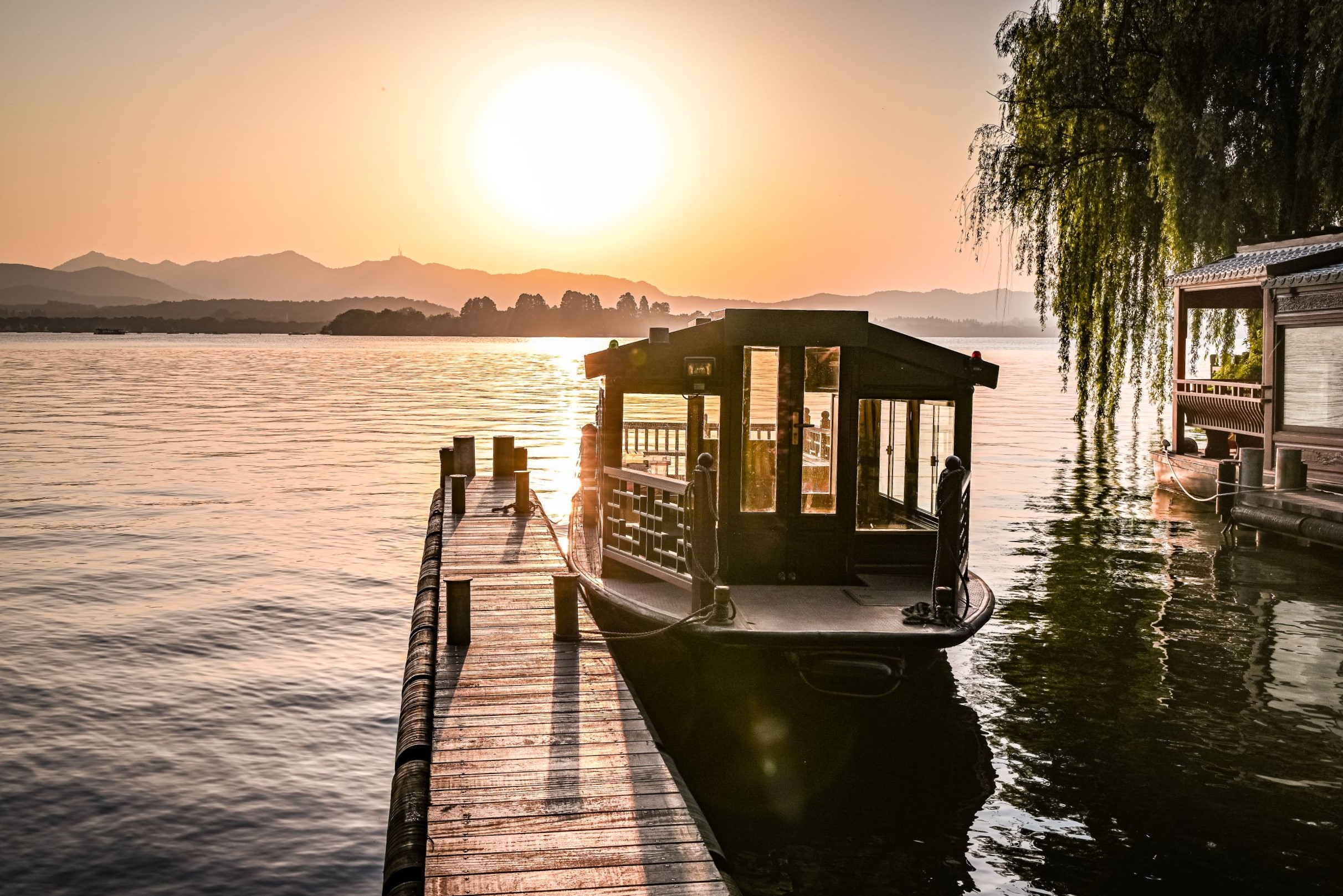
The West Lake is the epitome of classical beauty in China and is totally mesmerising: pagoda-topped hills rise over willow-lined walkways, delicate bridges, intriguing pavillions, parks and gardens around the banks of the lake offer a gift of beauty to any observer.


The boats cruise leisurely and seamlessly, reaching islets that dot the calm waters.
Taking a cruise around the lake is a very popular activity and it adds to the charm of the experience.
This boat will take you to explore “Xiao Ying Zhou”or “Three pools mirroring the moon” island. You can stay on the island as long as you like. After visiting, you can take another boat to the pier.
–Piers to Board: pier at The First Park, at Children’s Palace, at Zhongshan Park, at Hangzhou Restaurant, at Yuefei Temple, at Huagang, pier at King Qian Temple (Qianwang Ci)
–Tickets: CNY 55/person (Xiao Ying Zhou ticket included)
- Opening Hours: 08:00~16:00


Sunrises or sunsets present a show of extraordinary visual poetry, no matter where you are around the expansive lake.
And speaking of poetry, Bai Juyi, poet and governor of Hangzhou during the Tang dynasty, brought the West Lake to splendour and fame by building the Bai Causeway and immortalized Hangzhou in his verses.

UNESCO declared the West Lake a World Heritage site in 2011. Spanning over 6 kilometers, the lake is divided into five sections by a mountain and three causeways.
Three islands stand in the lake and two pagodas face each other across the lake.

Watching the sunset from one of the many spots on the lake seems to be a favourite pastime of locals and tourists.


There are pagodas galore on the West lake and in Hangzhou:
The five-story Leifeng Pagoda, located on Sunset Hill, is the most popular and frequently photographed landmark of West Lake. Originally constructed in AD 975, it collapsed in 1924 but was rebuilt in 2002

Six Harmonies Pagoda (aka Liuhe Pagoda) is an octagonal structure first constructed in the 10th century. It once served as a lighthouse for vessels on the Qiantang River. Today a narrow staircase leads to a viewing area affording excellent views of the surrounding area.
Chenghuang Pavilion (or City God pavilion) on the top of Wu Hill, offer people a great view of Hangzhou and the West Lake
The pavilion is huge and is a recent construction. It tops seven-floors together with the underground. The whole pavilion is quite luxurious and features architectural styles of Yuan and Ming Dynasties.

But Hangzhou today is not just the West lake and wetlands. It has developed into a lively modern city with high rises, spectacular bridges, restaurants, bars and nightlife.
Finish your day with a walk on the Urban Balcony.
Just opposite the Intercontinental Hotel (the golden ball in the picture!) to take in the beautiful skyline.


Our next adventure: Zhujiajiao watertown!
For more China blog posts: https://blog.worldswithout.net/china/