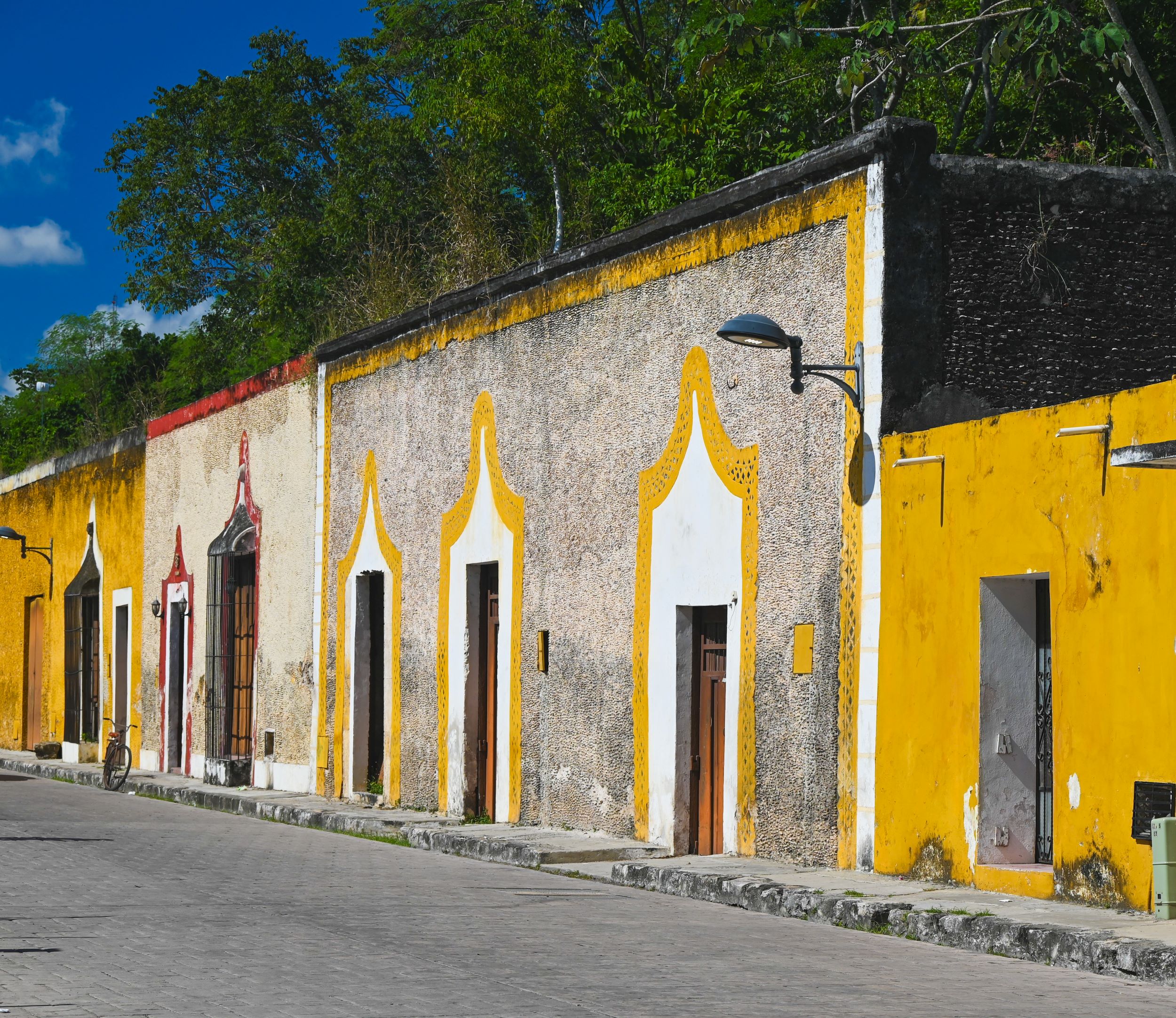
Discovering Izamal: The Yellow City of Yucatán
We left Valladolid by car and drove towards Izamal, a little town between Valladolid and Merida.

Made popular by its bright yellow buildings, it is acquiring more and more popularity. The city was painted yellow in honour of the visit of Pope John Paul II in 1993, as yellow (and white) is the colour associated with the Vatican and the Catholic Church.


The town is very much alive and vibrant with local life and we also visited during a local festivity which added to the lively atmosphere.

Convento of San Antonio
There were quite a few Mexican sightseers (or pilgrims?) visiting the imposing the ex Convento of San Antonio, the central piece of the town.
The convent was finished in 1561, having started in 1533 and my archaeologist heart hurt by the discovery, as sadly happens everywhere, that stones from a previous Mayan temple had been used to build the new centre of faith.

The stones stand prominently around the outside courtyard and in the stepping stones, intentionally positioned to be trodden on.

Unfortunately, the reappropriation of buildings and stones to claim a new faith was used throughout ancient history and it is even today.
This was done for several reasons:
leaving the old faith no worship centres, forcing the population to adapt to the new faith but at the same time giving them some sort of reassurance (possibly lying) that their new faith is similar and constructed with and on the previous one.

The convent is, in fact, built following a Mayan temple layout with a large central square outlining the four cardinal points. This approach aimed to provide the indigenous population with a sense of familiarity and continuity with their previous beliefs.


However, in Maya Yucatan, authorities swiftly established the Inquisition to forcibly convert those who continued to resist.
There is a statue just adjacent to the church of our good shepherd Friar Diego de Landa which, among other virtues, mentions “Inquisitor”.

Archaeologists identify Izamal as a significant Mayan worship centre, featuring five pyramids, with the convent constructed atop the central one.
Izamal Pyramids
In fact, other pyramids, or their remnants, stand scattered across various spots in the town.
The most remarkable is Kinich Kak Moo, today a nearly overlooked site, it is actually one of the most important structures of Mesoamerica;
its base measures 200 m by 180 m and the height of the upper temples is more than 34 m. It was built around 400-600 A.D and must have covered much older buildings.


There is no fee to enter, there is no gate, it’s just there for anyone to climb and admire. Local children play on it, adults sometimes have a picnic at the top.
It has integrated into the daily life of the people.
All in all, Izamal is a delightful place to spend a couple of hours or an afternoon. It is easily reachable by train (Tren Maya stops here) or by car. There are hotels and restaurants if you want to stop longer.