Discover Newgrange: unlocking Ireland’s remote past
Newgrange is one of Ireland’s most fascinating prehistoric sites. Located in the Boyne Valley, this UNESCO World Heritage Site is part of the Brú na Bóinne complex, which also includes Knowth and Dowth.
At the moment, the sites of Newgrange and Knowth are the only ones open to the public.
Newgrange offers a unique glimpse into Ireland’s ancient past, blending archaeology, mythology, and natural beauty.
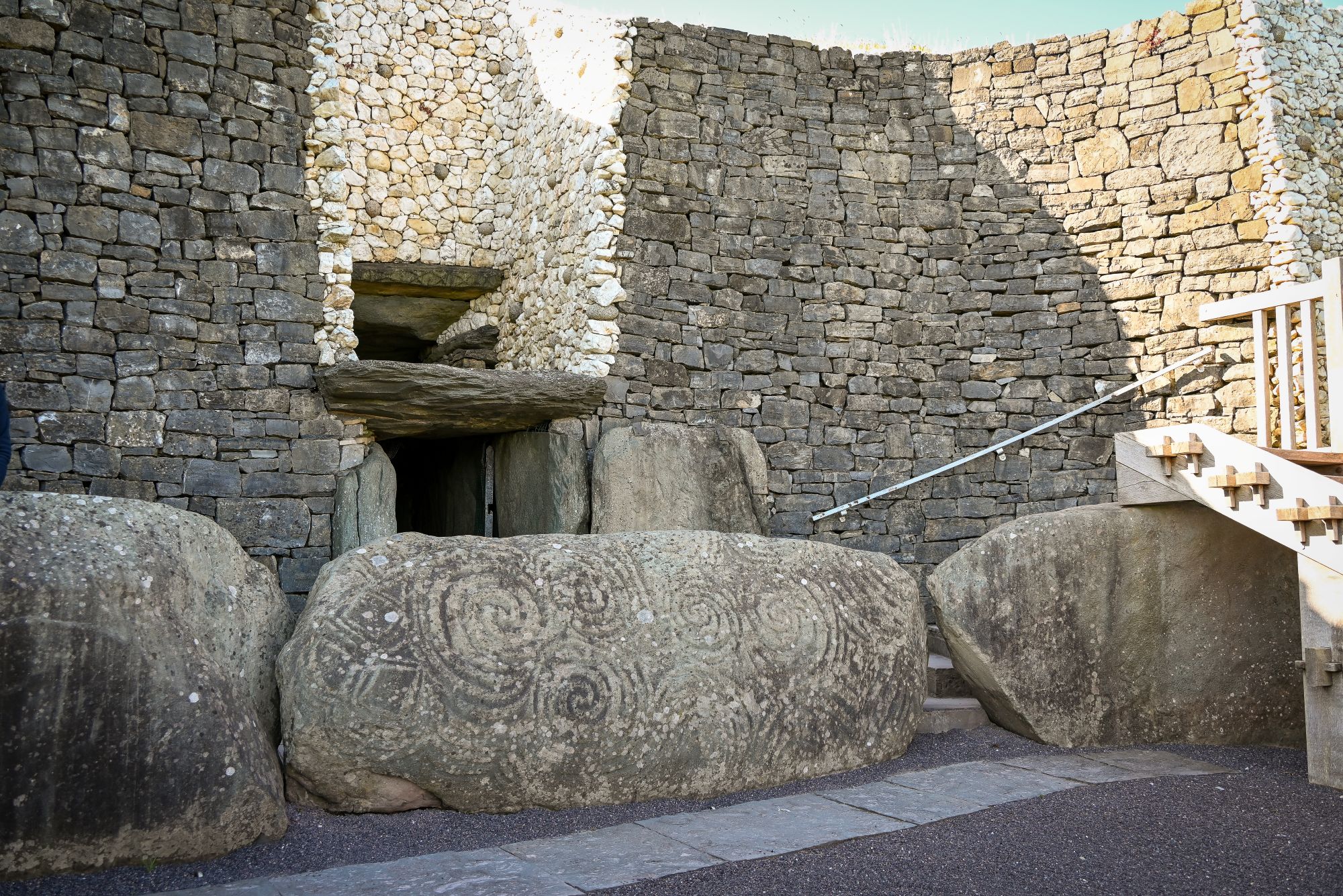
Built around 3200 BC, Newgrange is a passage tomb with a remarkable solar alignment—during the winter solstice, sunlight illuminates the inner chamber, a phenomenon that has captivated visitors and researchers alike. The tomb’s intricate megalithic art, featuring spirals and geometric patterns, adds to its mystery.


How to visit Newgrange
Access: Visitors must book a guided tour through the Brú na Bóinne Visitor Centre https://brunaboinne.admit-one.eu/
Tickets: Advance booking is essential, especially during peak seasons.
Experience: Tours include a visit inside the passage tomb, where guides explain its history and significance which is essential if one wants to understand the meaning behind it.
To visit the monuments at Newgrange and Knowth, visitors begin their experience at the Brú na Bóinne Visitor Centre. This centre serves as an interactive gateway, providing a comprehensive exploration of Neolithic culture, the landscape and the monuments located at the Brú na Bóinne World Heritage Site.
Shuttle buses then transport visitors from the Brú na Bóinne Visitor Centre to Newgrange and Knowth, where on-site guides are available.

The guides were very knowledgeable and explained the changes within the complex during the millennia. They even replicate the solstice event, when rays of the rising sun illuminate the most inner chamber.
How to get there
Newgrange is located in County Meath, Ireland, about 45 km north of Dublin.
Driving is, without a doubt, the easiest way to reach Newgrange. However, there are also other options:
From Dublin
By Car: The drive takes about 45 minutes via the M1 and N51.
By Train & Bus: Take a train from Dublin Connolly to Drogheda, then transfer to Local Link Bus Route 163, which runs to the Brú na Bóinne Visitor Centre
Viator offers several different tours to Newgrange: https://www.viator.com/tours/Dublin/Full-Day-Guided-Celts-and-Castles-Tour-from-Dublin/d503-24779P3?pid=P00250220&mcid=42383&medium=link

From Belfast
By Car: The drive takes about 2 hours, following the M1 south.
If you have your own transportation, there are many interesting sites nearby.
Hill of Tara: The Hill of Tara is one of Ireland’s most significant ancient sites, located in County Meath. It was the ceremonial seat of the High Kings of Ireland and holds deep connections to Irish mythology and history. The site is open year-round and free to visit.

Monasterboice: Monasterboice is an early Christian monastic site in County Louth, Ireland, founded in the late 5th century by Saint Buithe. It was an important religious centre until the 12th century, when nearby Mellifont Abbey took prominence. Don’t miss the Muiredach’s High Cross, considered the finest high cross in Ireland, standing 5.5 meters tall and adorned with intricate biblical carvings.
Bective Abbey: Bective Abbey is a Cistercian monastery on the River Boyne in County Meath, Ireland, founded in 1147. It was Ireland’s second Cistercian abbey, following Mellifont Abbey, and played a significant role in medieval monastic life. The abbey was used as a filming location for the 1995 movie Braveheart.
Admission: Free, open year-round.


For more Ireland blog posts: https://blog.worldswithout.net/europe/ireland/