Chongqing in 24 hours
First of all, Chongqing deserves a lot more time than 24 hours.
But, on our tight schedule, we tried to make the most of it.
For many, Chongqing is the start (or end) of their Yangtze cruise adventure. We were very tempted by it, but maybe next time.
It is one of China’s main cities and a commercial hub.
It has a urban population of an incredible 22 million people.
And believe me, at night, they will all be at Hongya cave!! Or that is what it felt like.


Chongqing is a very energetic, busy city.
The skyscrapers and the edge-cutting bridges clash seamlessly with the traditional style of the temples and some old streets.
It was one of our favourite places in this Chinese adventure.

Let’s see what not to miss:
Luohan temple
One of the most beautiful temples I have seen.
Buddhist monk Zu Yue built it during the Song dynasty (960–1276), now it is sandwiched between skyscrapers. Nearly destroyed by Japanese air raids in 1939 and further damaged during the republican times, the Central Committee of the Chinese Communist Party, following the national policy of free religious belief, officially reopened Luohan temple to the public in 1984.


Even though some parts were reconstructed, it’s easy to see that the temple is quite old.
The smoke of the incense spreads amongst the ornate columns and the grand halls. Tourists mix with the worshippers.
It seems quite a world away from the hustle and bustle of the metropolis a few meters away.


We left the temple and made our way to Longmenhao, on the banks of the river Yangtze.

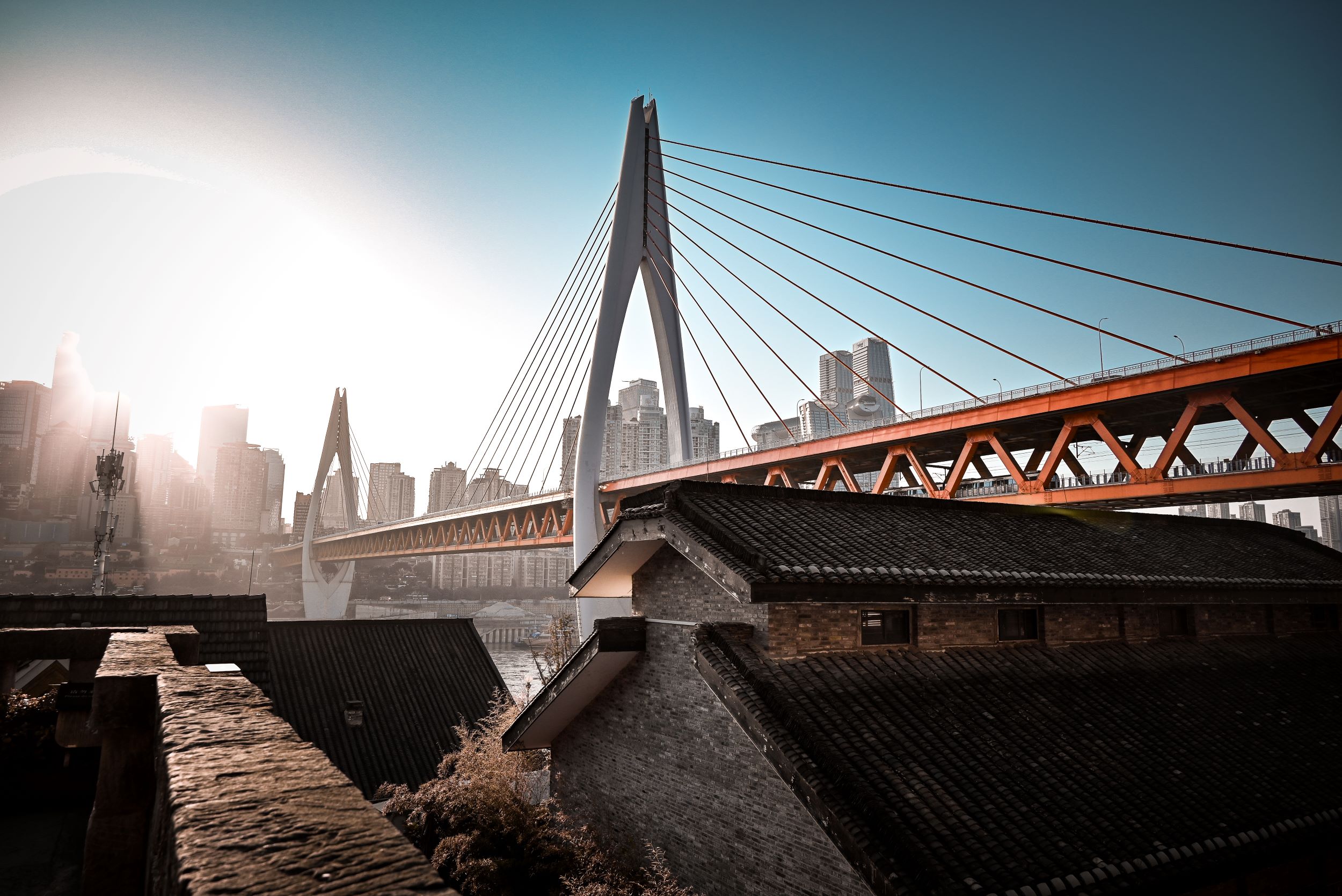
The view of the bridge is quite stunning from this area and even better if one crosses the road and climbs up the “old city street”, the best-preserved and largest historical and cultural old street in urban Chongqing.

The “old street” is nowadays an array of little shops and teahouses for tourists. Nevertheless, the view is amazing. And the prices to match.


Our next stop was watching the sunset at Hong’en Si park and its famous pagoda Hong’En Fang, a beautiful structure of seven floors, built in ancient traditional Chinese style that, when lit up at night, looks like floating on air.

The traffic stopped us from enjoying the sunset, but we still enjoyed an incredible sight as we watched the pagoda slowly being illuminated


The pagoda has been recently constructed, it is not old, but it has become a selfie- magnet and a new Instagram must, so do expect quite a lot of people.


And our last stop: Hong Ya Dong, the most famous spot in Chongqing.
Hong ya cave is an 11-story stilt-building complex in the main commercial district of Chongqing. Probably served as a fortress during the Qing dynasty, today the complex consists of shops and hotels.


The fourth floor of Hongya Dong has a very busy food market, and it is notable for Chongqing hot pot, allegedly hotter than the Chengdu’s counterpart.
If you go at night, the busiest and most beautiful time to appreciate it, prepare to be there with hundreds over hundreds of people. Although chaotic, police manage to keep the flow of people going and everyone seems to have a lovely time.


It was intimidating to look at, to be honest, but once you join the crowd, it was not actually too bad.
We had some food on the fourth floor and took in some spectacular views.
This was all we had time to do in basically one afternoon, but Chongqing has a lot more to offer:
The Ropeway of the Yangtze river, a cable car that stretches across the Yangtze River that runs through the city. It connects Yuzhong and Nan’an districts from Xinhua Road; the speed of the cableway is 6 meters per second, and the whole tour takes 4 minutes.


Ciqikou ancient town, a little old city built during the Ming and Qing Dynasties, and famous for their production of porcelain. The city boasts over a thousand years of history and houses one of the oldest Buddhist temples in Chongqing.
The Great Hall of the People is the meeting place of the Municipal Legislative Bodies and it resembles the Temple of Heaven in Beijing. It is stunning during both day and night when it is all lit up.
If you have more time, explore outside of Chongqing: Dazu caves, Wulong karst mountains, the White Emperor city.
I think you can easily stay a week in Chongqing and not be bored one minute!
We definitely want to go back and stay longer to explore all the sights we missed this time!
And now onwards to mellow Hangzhou.
For more China blog posts: https://blog.worldswithout.net/china/