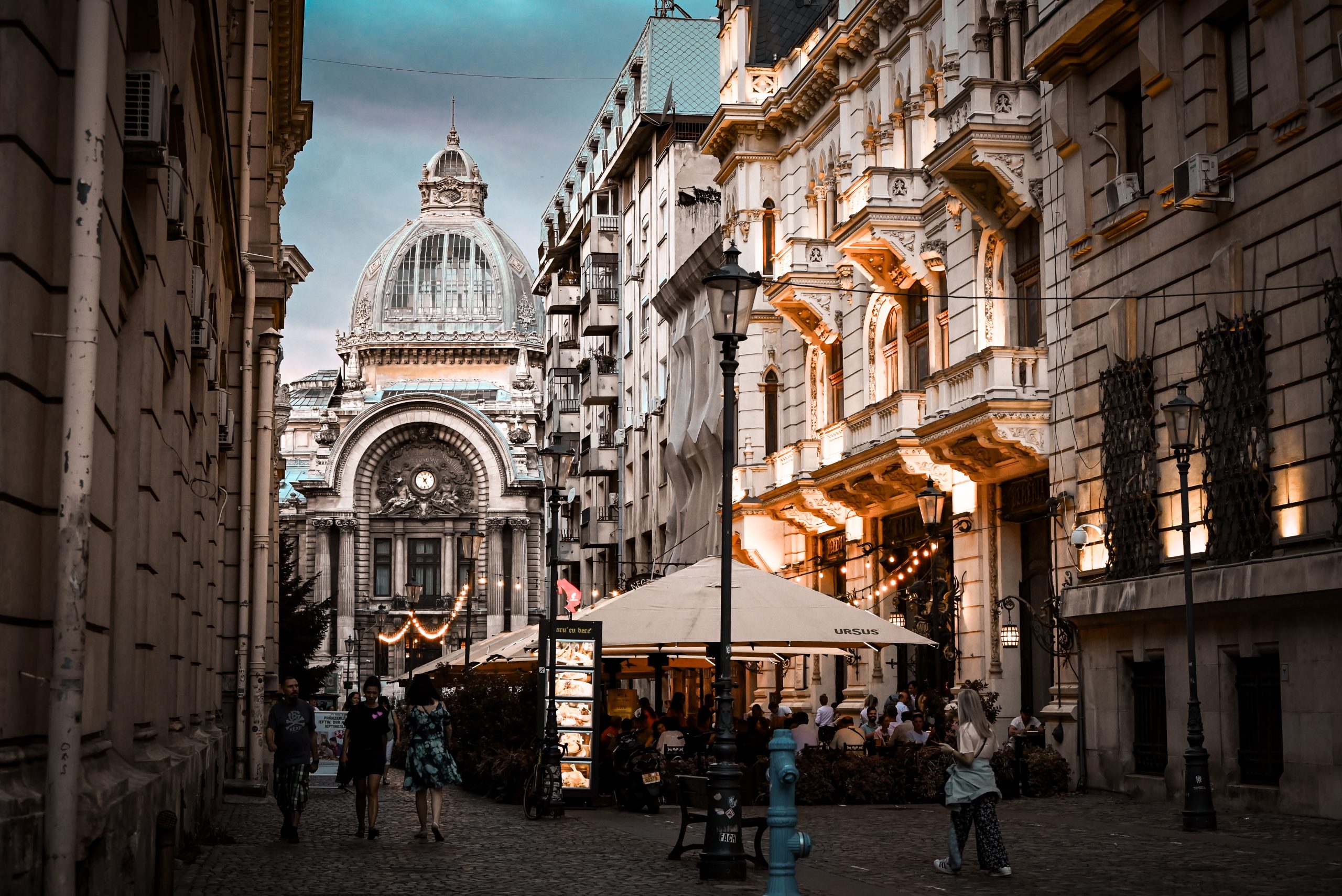
Bucharest: the raw gem of the Balkans
We fell in love with Bucharest.
It was the place that mostly surprised us in this two weeks adventure around the Balkans.
We were not sure what to expect and we were blown away by the cosmopolitan vibe and the beauty of its Belle Époque architecture.

Indeed, in the early 1900s Bucharest was known as “Little Paris” and it’s easy to see why.
Placed at the crossroads of Eastern and Western Europe, Bucharest, the vibrant capital of Romania, is a city that captivates with its eclectic mix of history, culture, and modernity.
Bucharest is a treasure trove waiting to be discovered by adventurous travellers. Whether you’re drawn by its rich architecture, lively nightlife, or delicious cuisine, this city has something for everyone.
Although many building nowadays are left abandoned, one can grasp the grandeur this city once had.

According to a legend, the city of Bucharest was founded by a shepherd named Bucur, whose name literarily means “joy” whose flute playing enthralled the people and the local wine made the city earned the nickname of “joyful city”.
Bucharest is well connected to the rest of Europe though its international airport and it is easy to reach other parts of the country by super cheap train or by not so expensive flights.
Start your journey at the heart of the city, where the grand Palace of the Parliament stands as a testament to Romania’s tumultuous past.

This colossal building, the second-largest administrative structure in the world, offers guided tours that take you through its opulent halls and reveals intriguing stories about its construction during the Ceaușescu regime.
One of the symbols of Bucharest is its own Arch of Triumph, built in 1922 to honour the Romanian soldiers who fought WWI.
Every weekend, June through October, visitors can climb to the top of the 90 feet-high structure, via an interior staircase, for a panoramic view of the city.
Calea Victoriei
Calea Victoriei (Victory Way) is Bucharest’s oldest and today’s main street.
Designed in 1692 to connect the Old Princely Court to Mogosoaia Palace, Calea Victoriei was originally paved with oak beams. In 1878, the street was renamed Calea Victoriei, to mark Romania’s victory in its Independence War against the Ottoman Empire.
In early 1920’s, Calea Victoriei became one of the most fashionable streets in the city and remains so to this day. The long avenue is flanked by decorated palaces, musea and cafes.


Strolling down Calea Victoriei, you’ll come across the Romanian Athenaeum, an active performing theatre and one of the most beautiful I have ever had the privilege of visiting!
The opening times to the public vary, as it depends if there are rehearsals ongoing; the price is less than £2.


Financed almost entirely by the general public, the Romanian Athenaeum was completed in 1888. Its high dome and Doric columns resemble an ancient temple. The lobby has a beautifully painted ceiling decorated in gold leaf, while curved balconies cascade in ringlets off a spiral staircase. A ring of pink marble columns is linked by flowing arches where elaborate brass lanterns hang. Inside the concert hall, voluptuous frescoes cover the intricated gold leaf ceiling and walls. Renowned worldwide for its outstanding acoustics, it is Bucharest’s most prestigious concert hall and home of the Romanian Philharmonic Orchestra.
It is a must see.
Old Town
Resuming walking down Calea Victoriei, you’ll pass Revolution Square, the National museum and the Palace of the Savings Bank, Romanian first Savings Bank, which has a large central glass dome, flanked by four smaller domes. The arch at the entrance, with its Corinthian columns, is a highlight of any architectural tour of the city.
From there, immerge yourself into Old Town Bucharest / Lipscani street Area.

Likely established during the 1400s when merchants, Romanian, Austrian, Greek, Armenian and Jewish, decided to set up shop in this part of the city, today the area is known as Lipscani, named for the many German traders from Lipsca or Leiptzig.
Other streets took on the names of various old craft communities and guilds, such as Blanari (furriers), Covaci (blacksmiths), Gabroveni (knife makers) and Cavafii Vechii (shoe-makers), quite common in Medieval settlements (same in my native Palermo).
The mix of nationalities and cultures is reflected in the mishmash of architectural styles, from baroque to neoclassical to art nouveau.
Today, the area is home to art galleries, antique shops, coffeehouses, restaurants and night-clubs; it is a lively area day and night, without being overwhelming so.
The city is dotted with cozy restaurants and modern bistros that serve both authentic fare and contemporary twists. Be sure to try a glass of palincă, a traditional Romanian fruit brandy, to round off your meal.


As the sun sets, Bucharest transforms into a lively hub of nightlife.
The Old Town comes alive with music, laughter, and energy, offering an array of bars, clubs, and live music venues. Whether you prefer a laid-back pub to enjoy local crafted beers or a dance club to groove the night away, you’ll find plenty of options to suit your mood.
For a unique experience, consider visiting a traditional Romanian tavern where you can enjoy folk music and dance
Restaurants not to miss
Hanul lui Manuc is one of the most popular restaurants in Bucharest; it is touristy but not a tourist trap.
Built in 1804 at the request of a wealthy Armenian trader, the inn hosted the preliminary talks concerning the Peace Treaty that put an end to the Russian -Turkish War (1806-1812).
Manuc’s Inn has preserved to this day its Medieval character and flavour.
Menu is extensive, there are veg options and do try the freshly baked bread!
There is live traditional music on most evenings.


The Church of the “Stavropoleos” Monastery, which we stumbled on by chance, is an Eastern Orthodox monastery for nuns, dedicated to the Archangels Michael and Gabriel.
The monastery was built in 1724 but only the church, out of the original building, has survived due to earthquakes; the frescoes and the interior cloister are beautiful and deserve a visit.


Cărturești Carusel is an iconic bookstore on two floors which sells books, games, souvenirs and different gadgets. It has become more popular due to Instagram fame and it’s worth a visit.

Caru’ cu bere is one of the most popular restaurants in Bucharest and it’s a must see, and possibly a must eat in there!
This old beer house became, soon after the opening in 1879, one of the most popular meeting places for Bucharest’s literati who would gather to discuss matters of their time. Its neo-gothic architectural style is reflected both in the façades and the interior decorations: columns, arches, chandeliers, a wooden staircase, furniture and murals on the walls and ceiling.
It is usually filled to the brim and it is advisable to book in advance.
It is not as cheap as other places, but the historical features of the place, the authenticity of the traditional food on offer, the handcrafted beers, definitely make it into an experience to be savoured!


Bucharest is a city that beautifully blends the old with the new, offering travellers a unique experience filled with charm and character.
We totally loved it and we promised to return!
Our next stop: let’s hop on the train to Sinaia, a very underrated charming town and the gateway to Transylvania.
Check my other Romania blog posts here:https://blog.worldswithout.net/romania/