From Sarajevo to Belgrade: the adventure begins
We wanted to see more of Western Bosnia but sadly did not have the time, so when I found a tour online, where we could depart Sarajevo, reach Belgrade and visit some places as we went along, it seemed to meet our wishes. And indeed it did not disappoint.
This is the link for the tour
Sarajevo to/from Belgrade UNESCO Transfer Day Tour
We were picked up by a minivan, in the morning, at our hotel in Sarajevo, and we left towards the hills of Western Bosnia. With us, on the tour, there were only two other girls, the driver and our lovely guide.

Our first stop was at a Medieval burial site, a necropolis located near Rogatica, hidden in the forest.
We climbed up a small hill, five minutes’ walk, with a crisp early morning air and the beautiful surroundings of the Bosnian hills. The mist was lifting to welcome a new day and the dew was glistening on the leaves.

The tombs emerged from the ground, overbearingly, seemingly unwilling to be forgotten.

The decorations, on the tombs, were all different, from crosses, to animal shapes to abstract symbols.
No one knows who buried who there, 212 tombstones have been recorded but no inscriptions.

After around one hour drive, we arrived at our second stop: the Mehmed Pasa Sokolovic Bridge over the Drina river in Visegrad, UNESCO site.
The bridge was completed in 1577 by the Ottoman court architect Mimar Sinan, one of the greatest architects and engineers of the classical Ottoman period, on the order of the Grand Vizier Mehmed Paša Sokolović.
It is truly an impressive site.


After admiring the bridge and taking the ritual photos, we went on a short boat ride on the Drina river which was delightful, watching local people fishing on their boats, the blue sky meeting the green river only interrupted by the huge stone bridge.
Andrićgrad
We then explored the stone town of Andrićgrad, a small stone town, built, named and dedicated to the renowned novelist Ivo Andrić. The site also means to explain the story of the once glorious and very successful Yugoslavian cinematography from the perspective of one of the best local directors, Emir Kusturica. This is the second village Kusturica created from scratch, after Küstendorf ,which we will be visiting later on. The town has a good number of shops, a restaurant, a cinema, a book shop and a gallery.


We left Andricgrad and continued on towards the Serbian border. Just before crossing, we stopped to visit the beautiful Dobrun Monastery.
Dobrun Monastery
Set in extensive greenery, with a river on its doorstep and mountains for backdrop, the scene already poses for an idyllic retreat of peace and uplift.
Builders started its construction in the 14th century, establishing one of the oldest churches in Bosnia. During World War II, the Nazis bombed it, causing significant destruction, though it was not completely demolished.


A small stone wall managed to salvage many of the frescoes, allowing reconstruction work to begin almost immediately, following the end of the war. The monastery has since become an important point of worship for followers of the Serbian Orthodox faith, and the monastery is still active today.
We crossed the border into Serbia and were met by the “Šargan-Mokra Gora” national park, where we stopped at Küstendorf , also known as Mećavnik, the second town built by Emir Kusturica.
It is appropriately named Timber town as all the buildings are made of timber. We had some time to explore, there are shops, a small church and we sat down at one of the restaurants with an incredible view over the Serbian valleys.


After lunch, we arrived at a small train station to experience the famous Šargan Eight, a narrow-gauge heritage railway in Serbia. Starting from the village of Mokra Gora, we rode on a steam train to Šargan Vitasi station, enjoying a delightful journey along the way. Šargan Eight is a masterpiece among similar railways and it connected Belgrade to Sarajevo, from 1925 until 1974.


After our enjoyable steam train drive, we continued on by minivan and entered the lush Tara National Park. Our stop here included a short trek of approximately 15 minutes to reach the famous viewpoint of “Banjska Stena”, which offers a fantastic panorama of Perućac Lake on the Drina River.
It is a little bit of a climb, but absolutely rewarding.

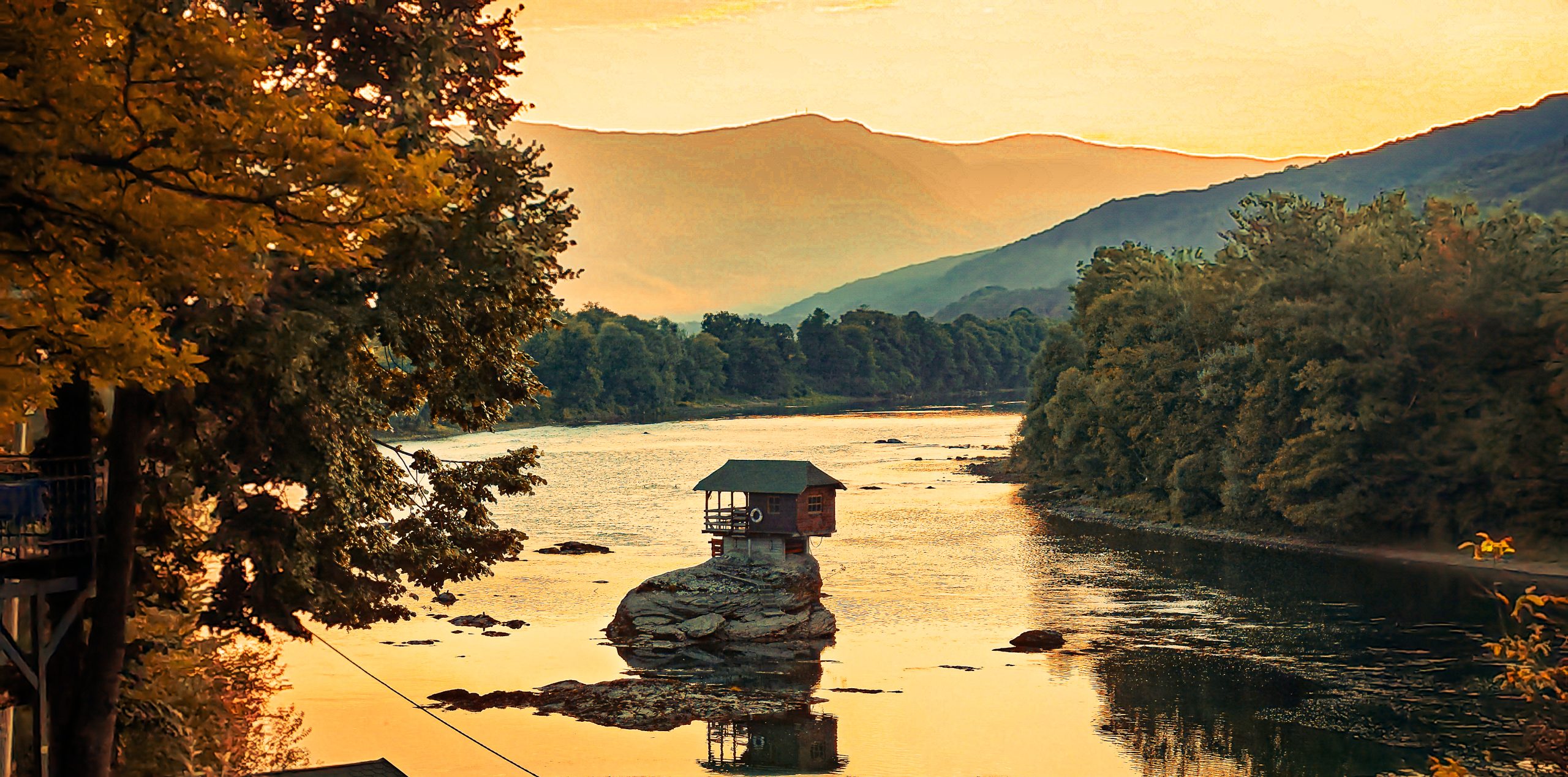
House on the Drina
Only stop left: the bizarre but absolutely charming House on the Drina, a small wooden house built, somehow, on a rocky bolder on the river Drina. We were there in time for sunset and it was magical!

Departing the last stop, still awaits you another 3 hours ride by minivan to get to Belgrade.
They had hoped to be there for 8, we actually arrived around 10, after more than 12 hours’ drive, exhausted, hungry but completely satisfied.
We loved every minute of it and we saw so many sites which we would not have been able to visit otherwise.
I thoroughly recommend this tour if you want to know more about the region.
It was not the first time that we had visited Bosnia, having been to Mostar a few years before, and Bosnian people always surprise us with their warmth, their hospitality and generosity.
The region is incredibly luxurious, with green hills, blue rivers and lakes and flowers. It has not yet been destroyed by mass tourism, hotels and recreation facilities. It is relatively unspoilt and this makes it special.
I hope it will stay like this.
Next adventure: Belgrade.
For more Bosnia blog posts: https://blog.worldswithout.net/europe/bosnia-and-herzegovina/