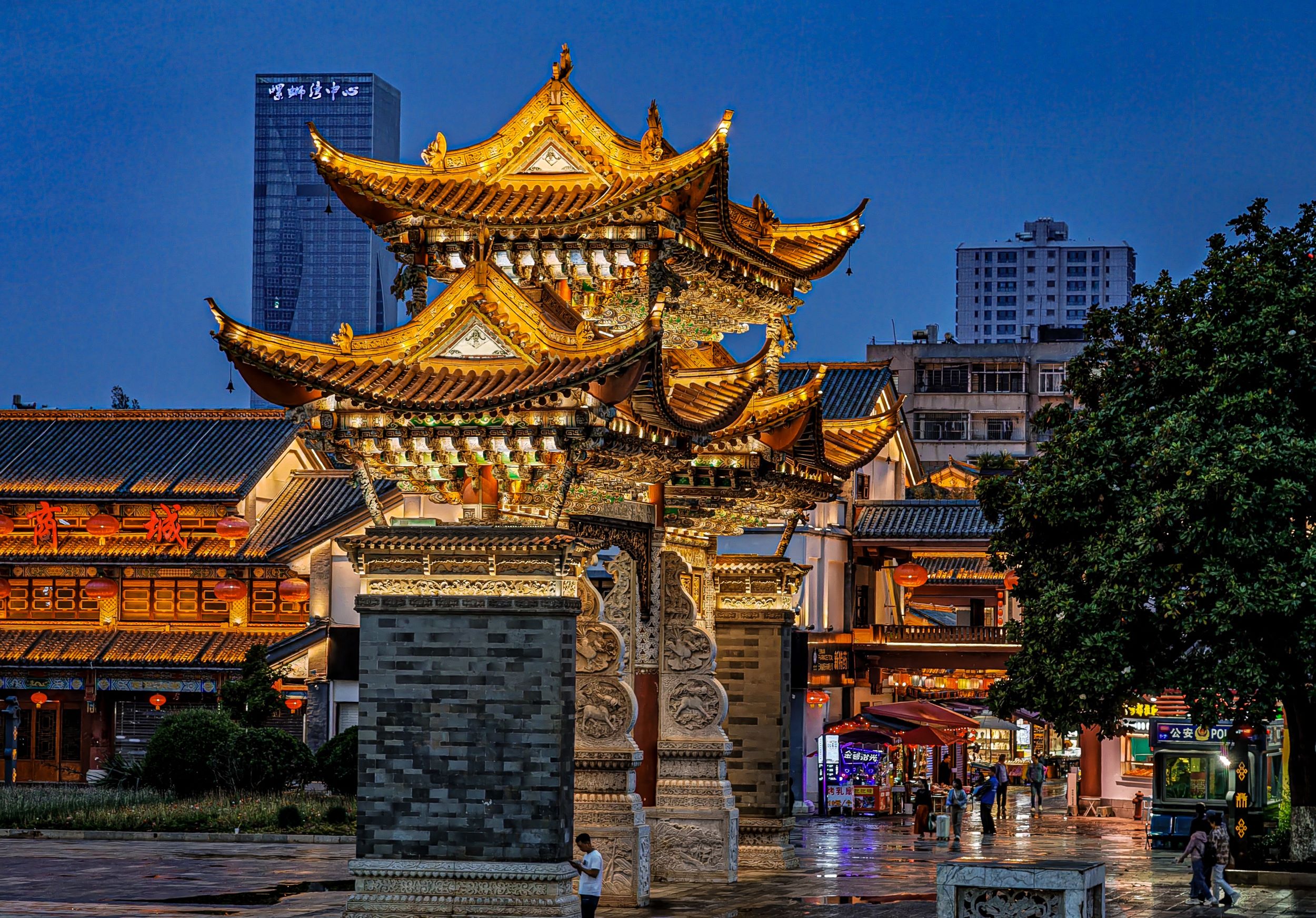
24 hours in Kunming, Yunnan
Welcome to Yunnan!
Kunming is the capital of the Yunnan province, in south-west China.
Yunnan is China’s most ethnically diverse province.
The Han ethnicity accounts for just 67% of the population, the remaining 33% of Yunnan is divided among 25 official ethnic minorities, representing nearly half of China’s list of 55 official ethnic minorities.

Yunnan was part of the Southwestern Silk road connecting the now Middle East and China and the Tea Horse Road between China and Tibet.
It is also the start of high altitude China, as Kunming sits at 1900 mt above sea level.
Kunming is easily reachable by bullet trains and by plane.
We stayed at a local hotel overlooking Jinbi park (Kunming Jinlangyuan Hotel (Nanping Pedestrian Street Jinma Bijifang Branch)) and its iconic gates, while the pedestrian Nanping street was just across the road.
Nanping street comes alive after dusk, with its neon lights, shopping centres and alleyways full of eateries. There are many stalls offering a wide range of street food and it is delicious.


Yuantong temple
This Buddhist temple is one of Yunnan’s oldest as it was first built in the late 8th and early 9th century, during the Tang dynasty.


After two major restorations, the temple took on its present design, with covered corridors, bridges and grand halls.
The price of the ticket is 6 RMB (around £0.65)


Cui Hu- the green lake park
In the 17th century, people established Green Lake Park, which is sometimes described as a ‘Jade in Kunming.
It is quite an extensive park, with four interconnecting lakes and bridges, vibrant flowers, willow trees and bamboos, swimming ducks and enchanting souvenirs.
I got home with some of them!
It is a perfect place to unwind and relax after a busy day sightseeing.


Unfortunately the weather got in between our plans and we missed the Yunnan Nationalities village: the theme park’s major goal is to display some aspects of Yunnan’s ethnicity, cultural diversity, and heritage.
The village represents 26 ethnic groups: Dai, Bai, Yi, Naxi, Wa, Bulang , Tibetan, Hani, Lahu and many others.
Definitely worth reaching out to, a DIDI to get there costs around £5.


Our next stop: the bullet train for the two hours journey to Dali town.